
Authored by: Lorenza Gervasio & Antonio Tria
Abstract
Recent controversies with the Al-Masri case have led Italy’s cooperation with Libya to raise legal, ethical, and diplomatic concerns, bringing the Italy-Libya 2017 Memorandum of Understanding to the center of the current political debate. The policy paper investigates the origins of the Memorandum, evaluates its outcomes, and points out core issues of Italy-Libya cooperation. The paper also applies Greenhill’s theory of Coercive Engineered Migration (CEM) to emphasize how Italy’s political dynamicsand geopolitical vulnerabilities play a role in the memorandum. Most importantly, the paper highlights how the doubtful effectiveness of the Memorandum came at a huge human cost. Four main policy recommendations are proposed:(1) introduction of enforceable penalties for disputes regarding the interpretation of the memorandum, (2) enhanced transparency and accountability of Italian funds, (3) establishment of a permanent third-party safeguarding human rights, and (4) memorandum alignment with constitutional norms. As the Memorandum approaches its automatic renewal in February 2026, Italian policymakers are urged to revise the agreement, regulating migratory flaws while ensuring the respect of human rights and constitutional legality.
Introduction
Since January 2025, Italy has been under scrutiny from the international community due to the Al-Masri case. The Libyan General Osama Najim Al-Masri is formally regarded as Head of the Libyan Judicial Police. Yet, the facts in which he is involved have led international actors to label him a criminal and the head of a local militia. InOctober 2024, the International Criminal Court (ICC) issued a warrant for his arrest, since Al-Masri is accused of torture, violence, and crimes against humanity. Thereafter, when Al-Masri arrived in Italy, the national government had to arrest him. Indeed, Meloni’s government did so, but eventually, after 48 hours, Al-Masri was released and sent back to Libya by an Italian State flight.[1] The ICC, indeed, acted and started an investigation into Italy. At the same time, European states expressed their concern in response to the Italian decision to release such a violent and dangerous individual.
The Al-Masri case highlights a peculiar relationship between Italy and Libya. Being the nearest African neighbor to Italy, Libya is one of the most involved actors in the Mediterranean issue of migration. To draw an updated analysis of the subject matter, this policy paper uses the 2017 Italy-Libya Memorandum as a starting point to evaluate its effectiveness, but most importantly, its future implications. This is a particular point in time to talk about this issue because the Memorandum of understanding on cooperation in the fields of development, the fight against illegal immigration, human trafficking, and fuel smuggling, and on reinforcing the security of borders between the state of Libya and the Italian Republic has a 3-year validity; therefore, in February 2026 the Memorandum will be automatically renewed unless one of the Parties presents a notification of withdrawal at least 3 months in advance.[2]
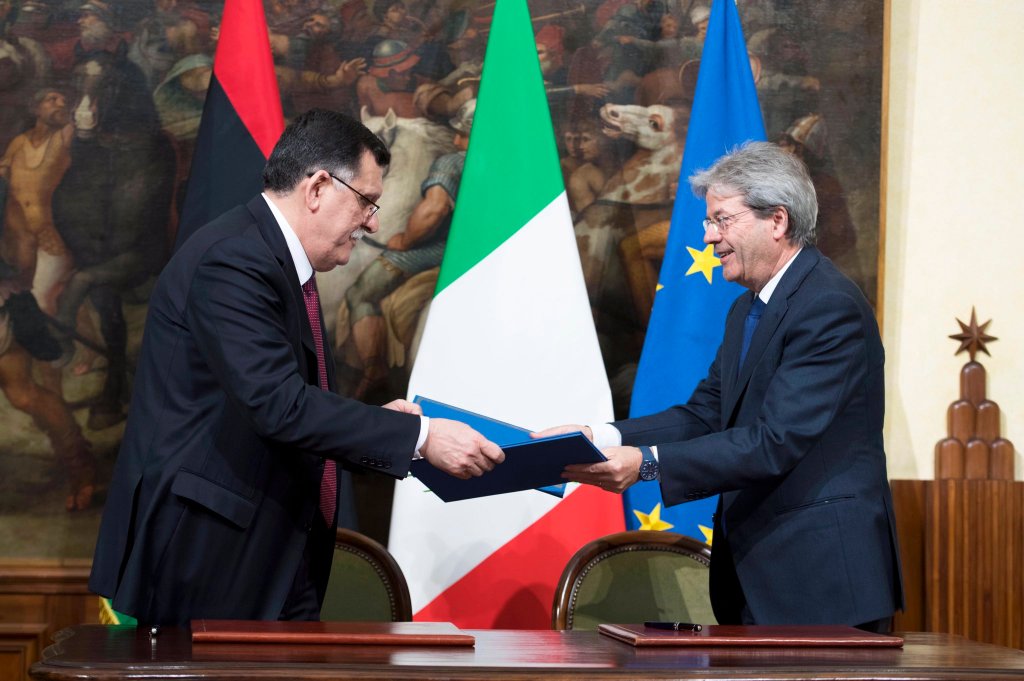
Italy and Libya are characterized by very different legislative and governmental dynamics. Indeed, Libya was considered a Pariah State under the Gaddafi regime for neglecting the principles of democracy, leading the state to be an outcast in the international community and face international isolation.[3] However, the parties are actively involved in mutual migration issues, as theArab Spring – a massive immigration crisis over the previous decade – further strengthened bilateral foreign affairs. The Memorandum was signed by the Italian President of the Council of Ministers, Paolo Gentiloni, and the Prime Minister of the Libyan Government of National Reconciliation, Fayez al-Sarraj.
A fundamental problem regarding the efficiency of this alliance lies in the historical and technical division within Libya. The Memorandum ought to be a bilateral agreement, but the Libyan internal divisions make it harder for Italy to have a solid and reliable Libyan counterpart.
After the fall of the Gaddafi regime in 2011, Libya has been characterized by the presence of two competing governments – the Government of National Accord/Reconciliation (GNA)and the Government of National Security (GNS) – undermining administrative unity and efficiency. Both governments impose their tools and mechanisms to gain support, competing for influence at the municipal level and among international actors.[4]
Nowadays,migration is one of the most discussed topics by politicians. Nonetheless, there is much unsaid regarding this issue. The Al-Masri exemplifies the problematic dynamics between states that ought to be strategic, but lack accountability and transparency, while putting at stake Italy’s international status. This policy paper aims to evaluate the most recent agreement between Italy and Libya, which is the Memorandum from 2017.
The urgency of this issue stems from the fact that Italian politicians, already before the Al-Masri case, committed to the public and all the NGOs that advocate for human rights protection to modify and adjust the critical issues of this relationship with Libya. However, what happened with Al-Masri is clear evidence to the contrary, making Italy appear internationally as willing to undermine and hide the atrocities taking place in Libya. The policy paper’s objective is to provide the reader with a solid analysis of the memorandum to understand current and future developments, particularly regarding the upcoming potential renewal. Given the latest developments renewed the global community concerns about human rights and migration-related policies, policymakers are called for an adjustment to the Memorandum, to preserve Italy’s international reputation.
Analysis of the Memorandum
The diplomatic relation between Italy and Libya, whose main element lies in the geographical proximity of the two countries, has long been – and continues to be – characterized by complex and often ambiguous events, starting from a troubled colonial history, an unstable succession of political regimes, and geopolitical interests that have always made the African country a strategic object of conflicts and opportunities. During the Gaddafi regime(1969-2011), Italy and Libya established contacts in various fields, ranging from politics and culture to economy and technological progress, but the issue that has always been the focal point of bilateral agreements between the two states is undoubtedly migration.
The agreement between the Government of the Italian Republic and the Great Socialist People’s Libyan Arab Jamahiriya for Cooperation in the Fight Against Terrorism, Organized Crime, Illegal Drug Trafficking, and Illegal Immigration (2000) was the first to implement mitigation measures.[5] In 2007, the agreement was followed by an additional technical-operational protocol.[6] The signing of the Treaty of Benghazi (2008) completed the general framework of the fight against illegal immigration, bringing the number of landings back to the levels of the 2000s.[7] The trend was suddenly reversed by the advent of the Arab Spring (2011) and the consequent intense migratory flow towards Europe. Nevertheless, after the end of the intense Libyan Civil War (2011), the Tripoli Declaration (2012) sealed the friendship and diplomatic cooperation between the Parties.[8] In the following years, the humanitarian operation Mare Nostrum (2013-14) carried out by the Italian Navy saved over 160,000migrants, through a rescue area extending beyond the borders of the Italian national territory.[9] However, since the program expired in 2014, the governments of European Union (EU) member states and the European Commission have decisively shifted towards a policy of outsourcing border surveillance to manage migratory flows in countries of origin and transit. Nevertheless, this choice has exacerbated the migration crisis. In 2016, the number of migrant landings from Libya on the Italian coasts peaked at 12,000 in just 48 hours between June 25 and 27, 2017, an emergency fueled by the fact that Libya had long ceased to exercise any form of coastal surveillance.[10]
The Memorandum of Understanding (MoU) between Italy and Libya was signed in Rome on February 2, 2017, with the official goal of regulating and strengthening “the cooperation in the field of development in Libya” and “to continue on supporting the efforts aimed at national reconciliation, in view of a stabilization that would allow the formation of a civil and democratic State.” The necessary condition for achieving this development is identified in the text as “ensuring the reduction of illegal migratory flows, the fight against terrorism, human trafficking and fuel smuggling” and the “strengthening of border security between the State of Libya and the Italian Republic.”[11]
- Article 1 of the Memorandum concerns the “support and financing to development programs in the regions affected by the illegal immigration phenomenon,” as “the Italian party commits to provide technical and technological support to the Libyan institutions in charge of the fight against illegal immigration, represented by the border guard and the coast guard of the Ministry of Defense and by the competent bodies and departments of the Ministry of Home Affairs.”[12]
- It is worth noting that one of the most debated points in this regard concerns the lack of recognition of penalties or sanctions for disputes regarding the “Memorandum’s interpretation and application,” since, as stated in Article 7, “the disputes between the Parties will be friendly negotiated by diplomatic means,” indirectly leaving exclusive autonomy to the Libyan authorities in handling the matter.”[13]
- Article 2, the Italian side commits to the “adaptation and financing of the reception centers already active […] through the delivery of medicines and medical equipment, to the improvement of the illegal immigrants’ medical needs in the centers, in the treatment of communicable and serious chronic diseases.”[14]
The “training of the Libyan personnel within the above-mentioned reception centers […] supporting the Libyan research operating in this field” is also under Italian competence responsibility.[15] However, this training is indirect and not implemented through active field intervention. Instead, it is ensured exclusively through financial support, the management of which is entrusted to local authorities.
Criticisms
The Memorandum was signed “Treaty of Benghazi(2008) and the Tripoli Declaration (2012).[16] However, there is no continuity between the aforementioned treaties and the present text. Today, Libya is divided between two governments, without any political cohesion and struggling for legitimacy. On one side, the GNA, born after the 2011 civil war that ended with the fall and killing of Gaddafi, is based in Tripoli. It is recognized by the United Nations (UN) and the international community, under the leadership of Abdul HamidDbeibah, who has been in office since 2021 as a provisional prime minister with the task of bringing the country to elections. On the other side, the GNS, based in Benghazi, with leader Osama Hammad, appointed by the House of Representatives, but has in Khalifa Haftar, commander of the Libyan National Army and former Gaddafi officer, as its key figure. Italy’s diplomatic position within this geopolitical division is one of declared support for the GNA. The discontinuity concerning the contracting parties in the treaties preceding 2017 and in the current Memorandum thus appears evident.
The Memorandum led to immediate effects, as the number of landings from Libya recorded on Italian coasts, according to data reported by the Ministry of the Interior, collapsed from over 180,000 in 2016, before the signing, to 23,000 in 2018, a year after the agreement’s implementation. However, since 2021, migratory traffic has resumed being significant and prominent, reaching levels almost similar to those pre-Memorandum. This was mainly due to the abolition of theglobal mobility block caused by the COVID-19 pandemic, along with a loosening of European policies on the phenomenon and reduced international support that allowed NGOs and humanitarian organizations to resume intensifying rescue operations. In 2024, after the growing attention that the Meloni government has returned to place on the issue, intensifying diplomatic relations with Libya, the number of landings has significantly decreased again, and even the first available data for the current year confirms this trend.[17]
To the ambiguous and volatile results is then added the other side of the coin: eight years after the agreements, the human rights record of migrants intercepted in Libya is disastrous. According to data collected and published collectively by leading NGOs, including Amnesty International, Doctors Without Borders, and Save the Children, by the end of 2022, almost 100,000 migrants since the agreement’s signing had been intercepted at sea by the Libyan Coast Guard and forcibly returned to Libya.[18] The Missing Migrants platform has reported to date the death of at least 24,700 people in the attempt to cross the Mediterranean, thus confirming its sad primacy as the most dangerous migration route in the world.[19]
This all fits into a particularly unstable political framework, where violence against the population grows year by year, as do displaced persons. Based on theGeneva Conventionand rulings of the European Court of Human Rights, Libya is not considered a Safe Port.[20] Numerous UN reports, also confirmed by testimonies of migrants who manage to leave the country, state that being a migrant in Libya means being deprived of any rights andprotections, being subject to “widespread and systematic arbitrary detention, acts of murder, enforced disappearance, torture, enslavement, sexual violence, rape.”[21] The Memorandum provides support to the Libyan Coast Guard through funds, means, and training (Article 2). Since 2017, the Libyan Coast Guard has received over 100 million euros (57.2 million from the EUAfrica Trust Fund and 45 million solely through the dedicatedItalian military mission) for equipment and trainingof personnel assigned to reception centers, where people are subjected to inhumane and humiliating treatment.[22] Furthermore, the report by the UN Independent Fact-Finding Mission on Libya (2022) confirmed the links between Libyan authorities and local militias, as well as their involvement in the system of arbitrary detention, exploitation, and abuse of migrants and asylum seekers. In such a context, it is becoming increasingly difficult to track the funds and means sent through the Memorandum.[23]
A further critical issue emerges from the procedural methods through which the treaty was signed. Considering the financial and humanitarian impact, according to the protocol for the conclusion of international treaties provided by Article 80 of the Italian Constitution, the agreement should have been concluded in a solemn form and would have required parliamentary intervention. Instead, the Memorandum was adopted in a simplified form, exclusively through the executive power of the Government.[24] Italy, despite full international awareness regarding the inhumane treatment reserved for migrants and refugees in Libya, continues its program of financing and supporting Libyan actions, as provided for by the Memorandum. This could lead to a situation of shared responsibility between Italy and Libya for the perpetration of unlawful acts, such as the violation of the prohibition of torture, according to international law.
Theoretical Framework
Further insights to understand the broader context of the Memorandum can be gained through the theory of Coercive Engineered Migration (CEM) coined by Kelly M. Greenhill. CEM occurs when a country threatens to send a large influx of migrants to a target state unless specific concessions are made.[25] The ability to control migration flows grants such countries high coercive power and bargaining leverage. Empirical evidence suggests that this form of coercion is effective in at least 75% of identified cases, surpassing the success rate of economic sanctions. Unlike the latter, typically codified in legal frameworks, migration-based coercion is rarely explicit, due to reputational concerns particularly regarding human rights. While authoritarian regimes like Gaddafi’s Libya have openly employed this tactic, liberal democracies prefer diplomatic backchannels to avoid public scrutiny. Many instances of CEM remain undocumented, as governments fear domestic backlash if seen negotiating to block migration. CEM is most often employed by weaker authoritarian states against economically and militarily stronger liberal democracies. Target states face two primary costs: resource strain and political instability. While advanced democracies generally have the capacity to absorb large migrant inflows – as demonstrated by Germany’s acceptance of 1 million Syrians in 2015 – remains the key concern. Opposition to migration often stems from perceived cultural incompatibility or security risks rather than resource limitations.
The effectiveness of coercion depends on two factors. First, government accountability plays a crucial role. Democratic governments like the Italian one, being highly accountable to voters, must respond to public sentiment, making them susceptible to coercion. In contrast, authoritarian regimes can ignore public opinion or enforce extreme measures, such as border shootings, as seen in North Korea. Second, the balance of pro vs. anti-immigrant sentiment in the target country determines how coercion plays out. If most of the population supports immigration, the government is likely to allow migrants in, maintaining public support. If the majority opposes immigration, the government can adopt strict border controls without political costs. However, when pro and anti-immigrant groups are equally powerful, as could be claimed was the case of Italy before it started to explicitly implement migration measures with the Treaty of Benghazi (2008), the government faces political deadlockand has an incentive to negotiate discreetly with the coercing state.
A target state has three options in response to coercion. It can accept migrants without policy intervention, block migration through stringent border security, or negotiate with the sender to prevent migration flows. If the government is not highly accountable to its citizens, it can simply absorb migrants without public backlash, as seen with Turkey hosting 4 million Syrian refugees. Alternatively, it can take extreme measures to prevent migration without consequences, like North Korea’s approach. Libya’s coercive leverage on the EU unraveled in 2010 when Gaddafi overplayed his hand, demanding annual payments of €5 billion to prevent migration. His credibility collapsed, prompting the EU support for rebels that ultimately removed him from power after the Arab Spring (2011), disrupting both migration and energy agreements for a decade. Stability is crucial for sustained migration deals; if a coercing state lacks a reliable government, it becomes difficult for target states to negotiate.
Today, the EU seeks to reestablish economic ties with Libya, but with increasing anti-immigration sentiment due to the spread of far-right nationalist ideologies, Libya’s bargaining power has diminished. In this framework, Italy’s unique geographical and commercialrelation with Libya makes it a case of its own, as shown by the bilateral nature of the Memorandum. Despite the strong anti-immigration sentiment characterizing the Italian ruling government, the geographical proximity makes the danger appear more salient and eventually harder to manage. Therefore, stricter border controls are enacted, but this is done indirectly by granting exclusive autonomy to Libyan authorities, thus fueling the system of arbitrary detention, exploitation, and abuse of migrants and asylum seekers. This perspective becomes even more relevant when we consider the increasing commercial agreements that link the two countries, with 21% of Italy’s oil imports coming from Libya, which holds significant bargaining leverage in this regard.[26] The evolving diplomatic relationship between Italy and Libya, as certified by the increasing number of State visits held in Tripoli by the Italian PM, Giorgia Meloni, risks making the Memorandum silently appear as one of the many agreements that tie the two countries, hiding its critical consequences we have discussed so far.
Political Options
Existing alternative political options to the Memorandum Italy-Libya 2017 are limited. all Libyan camps in which people were victims of violence.[27] The Five Star Movement (M5S), instead, has shown a more volatile opinion and therefore unreliable political options. Actors like Luigi Di Maio, who was the Minister of Italian Foreign Affairs, shed more light on the decreasing number of migrant arrivals, rather than taking action to stop the unethical procedures of Libya, undermining their importance.[28] The Association for Judicial Studies on Immigration (ASGI)has been investigating the case since 2017. Unlike the above-mentioned political parties, ASGI has called for the direct cancellation of the Memorandum, or at least for unilateral cancellation by Italy. ASGI pushes for outside optionsfor creating the safest and legal ways for migrants to reach Europe, while requesting more supervision from the EU.[29]
Based on what was released by the Italian Embassy in Tripoli, Italy continues to finance Libya’s intervention on humanitarian assistance and protection, as well as in programs for the reconciliation and reconstruction of the state.[30] Although NGOs and political parties advocate for new political options to solve this ongoing issue, which will soon mark a decade, there is no record of recent updates by Italy. Instead, the Italian government leverages, once again, only on the reduction of the total immigration by sea. In February 2025, President Meloni at the Conference of Italian Prefects and Quaestors, did not make any reference to Libya and the Al-Masri case but highlighted the reduction of arrivals by sea of 60% compared to 2023 and 35% compared to 2022.[31]
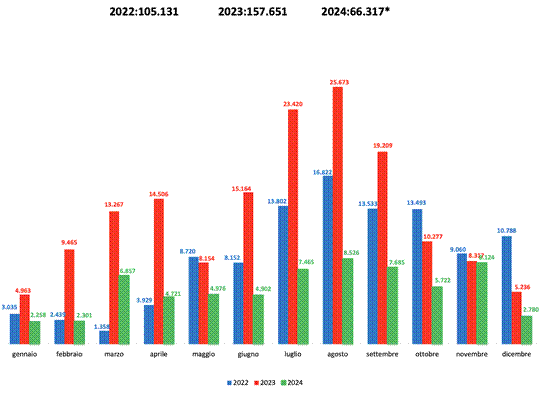
Dipartimento della Pubblica Sicurezza, Cruscotto Statisco Giornaliero [32]
The resolution of the problems about the Memorandum Italy-Libya, however, cannot exclusively be drawn from data about immigration. For instance, this chart from the Italian Ministry of the Interior comparing the number of landed migrants suggests that the data is preliminary (2024 is followed by an asterisk). Additionally, raw numbers do not explain why landings may have increased or decreased. What is most important for the subject matter of this paper is that the data only focuses on landings, not accounting for conditions in reception camps or deaths at sea.
Recommendations
Based on the information provided in this policy paper, we highlight four main recommendations for policymakers to consider when dealing with Italy and Libya on these matters. Most importantly, these proposals are what we think politicians should consider in the prospect of the memorandum renewal.
- Recognition of penalties: Article 7 of the Memorandum establishes that eventual disputes arising between the parties will be negotiated through friendly diplomatic means. This provision implies a lack of recognition of penalties or sanctions regarding the interpretation of the text. Together with a high degree of autonomy left to Libyan authorities in achieving the goals set, this creates an even more significant flaw in the legal framework of the Memorandum, which therefore needs to be properly adjusted.
- Transparency: Italy provides financial support to Libya, which serves to train and equip the personnel. However, Italy does not have an active role in the implementation of such aid, leaving Libyan local authorities in charge of the actual management. This is a common unintended consequence of foreign aid, which already occurred in many instances (think about the Taliban’s interception of the UN humanitarian aid). Italy must, therefore, ensure transparency and accountability of its funding, meaning that it has to be clear who receives the money and how it is allocated by clearing any doubt regarding the eventual involvement of the Libyan militia in this process. A suggestion would be to establish an Italian competent monitoring body responsible for the supervision of a clear and correct allocation of funds in Libyan territories.
- Third parties: Transparency and accountability are also two important features needed to end any violation of human rights. The role of NGOs is pivotal, as they can quickly provide essential services and limit the damage caused by human rights violations. Italy should establish a permanent third party, such as a branch of the UNHCR, which already operates in those fields, to serve as a day-to-day guarantee that international standards for refugee rights are respected according to the Geneva Convention (1951). Although the Convention does not explicitly oblige Italy to verify the compliance to such standards by Libyan authorities, Article 33 and legal interpretation make any country responsible if its actions indirectly lead to human right violations.[33] This creates an implied obligation for Italy to ensure Libya is safe for refugees before starting any cooperation.
- Alignment to the Italian Constitution: The Memorandum is often the object of political debate as it was adopted in a simplified form, meaning that it was only approved by the executive, without parliamentary intervention. The Italian government conceived the Memorandum as a ‘technical agreement’ rather than a full treaty, therefore, under their interpretation, it did not fall under Article 80 of the Italian Constitution. Nonetheless, the ratification procedure remains highly controversial. A representative group of lawyers from ASGI (e.g. Ciervo, Crescini, Verrastro and Cecchini) have argued that the Memorandum should have gone through Parliament due to its political nature, its financial implications and its impact on human rights.[34] Considering the renewed salience of the situation and what is at risk for Italy’s international status, the Memorandum should be realigned with Article 80 of the Italian Constitution concerning the conclusion of international treaties, clarifying the need for parliamentary intervention in its ratification.
Conclusions
The Italy-Libya 2017 Memorandum reflects systematic flaws in the broader pattern of externalizing border control, which goes beyond a simple response to migration pressures. Although some data show temporary drops in migrant arrivals, transparency and accountability in the memorandum implementation are often overlooked, putting at stake Italy’s international reputation. The Italian government, therefore, cannot continue to prioritize numerical reductions in migration and political interests while ignoring the means through which these results are achieved. Considering the upcoming renewal of the Memorandum, Italian institutions are faced with a choice: uphold international human rights obligations or risk entrenching a foreign policy built on ambiguity. The Al-Masri case is not an isolated incident but a symptom of a flawed strategy that needs urgent political and legal revision. The path toward the re-establishment of Italian leadership in the Mediterranean inevitably requires confronting the darker realities of its foreign alliances, with a renewed commitment to core national values as the foremost priority. The need for an urgent shift in approach is not only a matter of ethical responsibility, but also of strategic necessity. If tangible reforms are not enacted, Italy risks compromising both its international credibility and the long-term stability it aims to promote through its foreign policy.
Cover image: Italy and Libya signing the MoU, 2017. Paolo Gentioli’s X profile
[1] “Italy’s Release of a Warlord Puts Meloni’s Entanglements with Libya under Scrutiny”, POLITICO, March 17, 2025, https://www.politico.eu/article/osama-al-masri-njeem-giorgia-meloni-libya-connections/
[2] Libyan Government of National Accord and Italian Government, Memorandum of Understanding on Cooperation in the Fields of Development, the Fight Against Illegal Immigration, Human Trafficking and Fuel Smuggling and on Reinforcing the Security of Borders between the State of Libya and the Italian Republic, February 2, 2017, https://eumigrationlawblog.eu/wp-content/uploads/2017/10/MEMORANDUM_translation_finalversion.doc.pdf
[3] List of the 13 Current Pariah States, Worlddata.info, https://www.worlddata.info/pariahstates.php
[4] Scribd, Public Administration in The Middle East and North Africa, Shahjahan Bhuiyan, Routledge https://www.scribd.com/document/739603276/Public-Administration-in-the-Middle-East-and-North-Africa-Shahjahan-Bhuiyan-1-2023-Routledge-9781032486215-8557f13418cccba4a7f5c9a7199
[5] Italy and Libya, Accordo tra la Grande Giamahiria Araba Libica Popolare Socialista e la Repubblica Italiana, 2000, https://file.asgi.it/accordo.italia.libia.2000.pdf
[6] Italy and Libya, Protocollo tra il Dipartimento della Pubblica Sicurezza del Ministero dell’Interno della Repubblica Italiana e la Libyan General People’s Committee for Public Security, Tripoli, December 2007, https://file.asgi.it/protocollo.italia.libia.tripoli.dicembre.2007.pdf
[7] PDL 2041, https://documenti.camera.it/_dati/leg16/lavori/schedela/apritelecomando_wai.asp?codice=16pdl0017390
[8] Tripoli Declaration, Camera dei Deputati, August 2, 2018, https://www.camera.it/temiap/2018/08/02/OCD177-3673.pdf
[9]Francesca Mogherini, Arrivi e salvataggi in mare, Consiglio Italiano per i Rifugiati, March 2019, https://cir-rifugiati.org/wp-content/uploads/2019/03/Arrivi-e-salvataggi-in-mare_approfondimento.pdf
[10]Ibidem
[11] Libyan Government of National Accord and Italian Government, Memorandum of Understanding on Cooperation in the Fields of Development, the Fight Against Illegal Immigration, Human Trafficking and Fuel Smuggling and on Reinforcing the Security of Borders between the State of Libya and the Italian Republic, February 2, 2017, https://eumigrationlawblog.eu/wp-content/uploads/2017/10/MEMORANDUM_translation_finalversion.doc.pdf
[12] Ibidem art. 1 comma C
[13] Ibidem art. 7
[14] Ibidem art. 2 comma 2
[15] Ibidem art. 2 comma 3
[16] Ibidem
[17]Ministero dell’Interno, Truscott Statistico Giornaliero, February 26, 2025. https://www.interno.gov.it/sites/default/files/2025-02/cruscotto_statistico_giornaliero_26-02-2025.pdf
[18] Amnesty International Italia, Memorandum Italia-Libia: 5 anni di illegalità e di crimini contro l’umanità, October 26, 2022, https://www.amnesty.it/memorandum-italia-libia-5-anni-di-illegalita-e-di-crimini-contro-lumanita/
[19]Missing Migrants Project, Data, https://missingmigrants.iom.int/data
[20] Tineke Steik. Parliamentary Question | Italian Court Ruling on Libyan Coast Guard Rescue Operations and Its Implications for the Legal Compliance of EU Funding | E-002089/2024 | European Parliament. https://www.europarl.europa.eu/doceo/document/E-10-2024-002089_EN.html
[21] Independent Fact-Finding Mission on Libya, OHCHR, https://www.ohchr.org/en/hr-bodies/hrc/libya/index
[22] Amnesty International Italia
[23] Independent Fact-Finding Mission on Libya
[24] COSTITUZIONE – Normattiva, https://www.normattiva.it/uri-res/N2Ls?urn:nir:stato:costituzione:1947-12-27~art80
[25] Kelly M. Greenhill, Weapons of Mass Migration: Forced Displacement, Coercion, and Foreign Policy, Cornell University Press, 2010, http://www.jstor.org/stable/10.7591/j.ctt7v70q.
[26] Marco D’Aloisi, Importa greggio I trimestre 2024: Africa al 38%, Libia torna primo fornitore. Unem (blog), May 30, 2024, https://www.unem.it/importa-greggio-i-trimestre-2024-africa-al-38-libia-torna-primo-fornitore/
[27] Maria Antonella Procopio, L’Assemblea nazionale PD approva all’unanimità l’odg sulla Libia, Partito democratico (blog), February 25, 2020, https://partitodemocratico.it/lassemblea-nazionale-pd-approva-allunanimita-lodg-sulla-libia/
[28]Migranti, Di Maio a Boldrini: ‘Interrompere accordo Libia sarebbe vulnus politico. Modificheremo in meglio il memorandum, Il Fatto Quotidiano, October 30, 2019, https://www.ilfattoquotidiano.it/2019/10/30/migranti-di-maio-a-boldrini-interrompere-accordo-libia-sarebbe-vulnus-politico-modificheremo-in-meglio-il-memorandum/5540613/
[29]ASGI, ASGI chiede l’immediato annullamento del Memorandum Italia-Libia, Asgi (blog), February 2, 2020, https://www.asgi.it/asilo-e-protezione-internazionale/asgi-annullamento-memorandum-libia/
[30] Internazionale, Ministero degli Affari Esteri e della Cooperazione, “Ambasciata d’ Italia Tripoli,” https://ambtripoli.esteri.it/it/
[31] Intervento del Presidente Meloni alla Conferenza dei prefetti e dei questori d’Italia, February 17, 2025, https://www.governo.it/it/articolo/intervento-del-presidente-meloni-alla-conferenza-dei-prefetti-e-dei-questori-d-italia/27686
[32]Ministero dell’Interno, Cruscotto Statistico Giornaliero, December 31, 2024, http://www.libertaciviliimmigrazione.dlci.interno.gov.it/sites/default/files/allegati/cruscotto_statistico_giornaliero_31_dicembre_2024.pdf
[33] Convention Relating to the Status of Refugees, OHCHR, https://www.ohchr.org/en/instruments-mechanisms/instruments/convention-relating-status-refugees
[34] Memorandum Italia-Libia: ricorso alla Corte Costituzionale, ASGI, Asgi (blog), February 28, 2018, https://www.asgi.it/asilo-e-protezione-internazionale/mancata-ratifica-parlamento-memorandum-italia-libia-ricorso-corte-costituzionale/


 Osservatorio Strategico Mediterraneo Allargato