
Key Takeaways
➢ Parliamentary elections in Moldova gave the pro-EU Party of Action and Solidarity (PAS) a majority with 50.03%, while the pro-Russia Patriotic Electoral Bloc (BEP) secured 24.6%, triggering protests and allegations of interference.
➢ The results reinforced Moldova’s westward trajectory, with Romania and EU leaders backing President Sandu.
➢ Ukraine stands to gain from a more resilient Moldova, reducing Russian leverage in Transnistria, but Kyiv may not receive equal EU support on accession.
➢ Hungary’s scepticism highlights internal frictions in Brussels over enlargement, while reforms to decision-making could dilute Orban’s veto power.
Latest Development
On September 28, 2025, the results of the parliamentary elections in Moldova were announced. The Action and Solidarity Party (PAS), led by Moldovan President Maia Sandu, obtained 50.03% of the votes, while the Patriotic Electoral Bloc (BEP), led by former Moldovan President Igor Dodon, secured 24.6%.
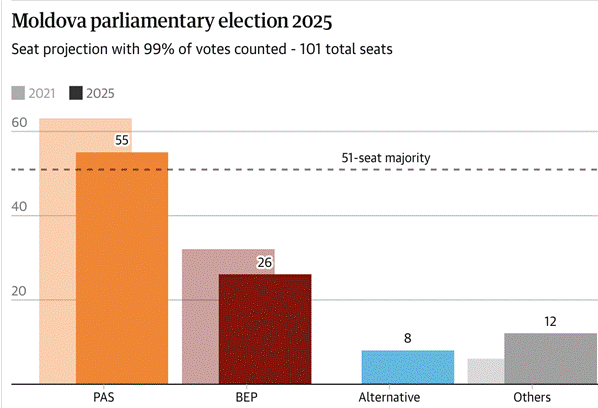
The two political parties indicate the historical dilemma faced by Moldovans. While PAS is known as a pro-Western and pro-EU party, BEP has closer ties with Russia, as it follows the Bloc of Communists and Socialists. These elections generated significant discontent from the BEP, as Igor Dodon called for peaceful protests in the capital, Chisinau. Additionally, two other pro-Russia parties, Moldova Mare and Heart of Moldova, were barred from the elections after being accused of Russian interference. As CNN reported, on election day, Moldova faced cyberattacks and false bomb threats at polling stations, particularly abroad in Italy, Romania, Belgium, Spain and the US, where many Moldovans reside. [1] In the following days, leaders from other states, such as Zelensky, expressed their support for Moldova, emphasising that electoral interference constitutes one part of broader subversive tactics with the power to undermine a rival from within.
Background
In 1991, Moldova gained independence from the Soviet Union. Since then, the country has faced an internal divide between those who maintain closer ties with Russia and those who believe in collaboration with the European Union. As of today, Moldova ranks among the poorer countries in the EU (although it is not yet an official EU member) due to a high inflation rate, massive emigration, and modest GDP growth.
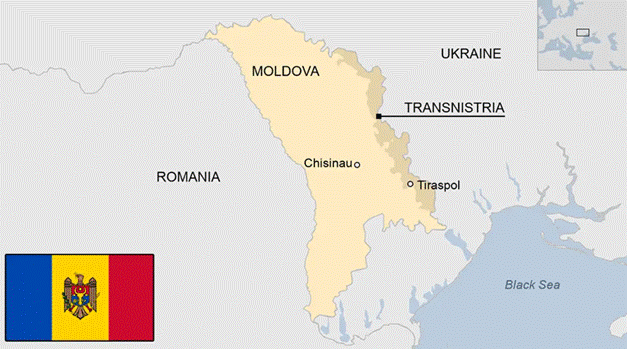
Since the war in Ukraine started, Moldovans have also dealt with additional problems as key trade routes were cut and an energy crisis expanded due to the suspension of natural gas supplies from Russia, leading them to rely more on their neighbour Romania through the OMV Petron Deal. [2] The map above highlights the region of Transnistria, which is essential to comprehend this story fully. The name Transnistria literally means “to the East of the Dniester River,” and it has been an independent region since 1990. Rikard Jozwiak explains that in this area, as of today, 1500 troops are backed by Moscow, but the fact that soldiers are locally recruited could make them more reluctant to fight for Russia in the case of future escalation. [3] Several analysts, however, have concluded that Russian troops in Transnistria do not pose an imminent threat to Moldova, but they are used as a deterrent to aspirations of joining the EU. [4]
Intelligence Assessment and Strategic Implication
The case of Moldova is core to many discussions among European states, but its status in relation to other countries has changed over time. In 2002, the UK pushed for a wider Europe initiative, and Moldova was included in what became known as the European Neighbourhood Policy (ENP). The ENP aimed to re-establish EU relations with old and new neighbours to ensure a new version of the enlarged Union. [5] However, this status can be maintained only until the neighbour does not aim to be part of the Union; indeed, the attribution of candidate status to Moldova in 2022 came with the expectation of full implementation of all commitments of the EU, thus ending the ENP. [6] Since then, Moldova has been part of the Enlargement and Eastern Neighbourhood Policy.
In the aftermath of the election results, the pro-West and pro-EU ideology appears to be the dominant one, but other states may hold diverging perspectives with regard to Moldova.
- Romanian President Nicuşor Dan is certainly taking a positive stance toward Moldova. In an interview, he said that throughout the negotiations, Romania will actively support Moldova. [7] It is, however, very likely that this position stems from strategic objectives, with Moldova being Romania’s neighbour to the east. Contrarily, it is very unlikely that Romania will adopt the same stance as it does with Ukraine. While Dan has declared that Moldova has all the cards to be an EU member, he also mentioned that “Ukraine’s agricultural production would unbalance existing EU mechanisms,” and therefore, different policies must be adopted. [8]
- Ukraine is very likely to benefit from PAS’s victory. Having a more resilient and pro-EU Moldova is likely to weaken the Russian presence in Transnistria, allowing Kyiv to increase defence in other areas. [9] At the same time, however, Ukraine is unlikely to experience the same support that Moldova received from other countries in the EU accession path. Nevertheless, as of September 2025, it has completed the screening process.
- Hungarian Prime Minister Viktor Orban is well known for his scepticism about EU enlargement. Indeed, he vowed to block Ukraine from joining the Union. [10] The latest developments, however, make it very likely that reforms regarding the decision-making process in Brussels will occur. As parliamentary elections will take place in April 2026 in Hungary, the final status of the veto power held by Orban at the moment will result from the outcome of the upcoming months.
- Although Moldova is not an effective member of the EU yet, its relations with the European Union are very strong and are likely to be finalised with its accession. Since the 1998 Partnership and Cooperation agreement, Brussels has supported Moldova by providing energy security, economic growth, and social development. [11] On one hand, some EU members are very likely to welcome the state Macron, Merz, and Tusk have been openly supporting Maia Sandu. On the other hand, the scepticism of countries like Hungary is likely to create frictions inside the Union. President von der Leyen said, “Our door is open. And we will stand with you every step of the way.” Therefore, the next months will determine the future of Moldova within the EU.
Conclusion and Recommendations
The outcome of Moldova’s parliamentary elections shows the country’s westward momentum, as well as the fragility of its democratic trajectory. Diverging positions within the EU highlight the internal frictions enlargement may provoke. Sustained Western engagement, particularly in energy security and institutional reform, will be essential to ensuring Moldova’s resilience and preventing Moscow from exploiting its divisions.
[1] Catherine Nicholls Regan and Helen Christian Edwards, “Moldova’s Ruling pro-EU Party Wins Election Marred by Claims of Russian Meddling,” CNN, September 29, 2025, https://www.cnn.com/2025/09/29/europe/moldova-election-eu-russia-intl-hnk
[2] “Romania’s OMV Petrom Signs Deal Covering Quarter of Moldova’s Gas Demand,” Energy, Reuters, May 7, 2025, https://www.reuters.com/business/energy/romanias-omv-petrom-signs-deal-covering-quarter-moldovas-gas-demand-2025-05-07/
[3] Rikard Jozwiak, “Wider Europe Briefing: Could Moldova Get Transdniester Back?” Wider Europe, Radio Free Europe/Radio Liberty, January 21, 2025, https://www.rferl.org/a/moldova-transdniester-unification-russia-ukraine-energy/33282420.html
[4] Stefan Korshak, “Explained: Russian Troops, Pro-Russian Forces in Moldovan ‘Separatist’ Transnistria Region,” Kyiv Post, September 25, 2025, https://www.kyivpost.com/post/60871
[5] Karen E. Smith, “The outsiders: the European neighborhood policy,” International Affairs Volume 81, Issue 4, July 2005, Pages 757–773, https://doi.org/10.1111/j.1468-2346.2005.00483.x
[6] Sieglinde Gstöhl and Christian Frommelt, “Beyond Downloading: Venues for Associated Neighbouring Countries to Influence EU Law and Policies,” JCMS: Journal of Common Market Studies 61, no. 6 (2023): 1512–28. https://doi.org/10.1111/jcms.13436
[7]Andra Diaconescu, “Exclusive: Romania’s President Dan Pushes for Moldova and Ukraine’s EU Bid, Challenging Hungary,” Euronews, September 30, 2025, https://www.euronews.com/2025/09/30/exclusive-romanias-president-dan-pushes-for-moldova-and-ukraines-eu-bid-challenging-hungar
[8] Diaconescu, “Exclusive,” September 30, 2025
[9] Daniel F. Runde and Thomas Bryja, “Moldova’s Fate Is Tied to Ukraine’s: Now Is the Time for the West to “Go Big” on Moldova,” CSIS : Center for Strategic & International Studies, October 6, 2024. https://www.csis.org/analysis/moldovas-fate-tied-ukraines-now-time-west-go-big-moldova
[10] Gabriel Gavin. “EU Must Unblock Moldova’s Membership Bid, Government Urges after Historic Vote,” Politico, September 29, 2025, https://www.politico.eu/article/eu-must-unblock-moldova-membership-bid-government-deputy-pm-gherasimov-historic-vote/
[11] “Moldova – Enlargement and Eastern Neighbourhood – European Commission,” September 30, 2025, https://enlargement.ec.europa.eu/european-neighbourhood-policy/countries-region/moldova_en
 Osservatorio Strategico Mediterraneo Allargato