

Key Takeaways
- Trump’s initial silence, followed by praise for Israel’s strike, shows a pattern of opportunism in foreign policy that carries diplomatic costs.
- The U.S. attack marked a sharp break from Trump’s isolationist promises and has sparked division within the Republican Party, especially among his MAGA base.
- Trump’s broader goal appears to be reshaping the Middle East, with a strategic plan to counter China’s influence via a “Cotton Road”.
- Iran’s retaliatory strike was calibrated to avoid escalation, showing Tehran’s intent to preserve credibility without inviting total war.
- With the announcement of a ceasefire, the long-term threat is not global escalation, but Iran resuming its nuclear program under even fewer constraints.
If both Iran and Israel continue not respecting the ceasefire, the possibility that the US will seek deeper involvement is remote.
Latest developments
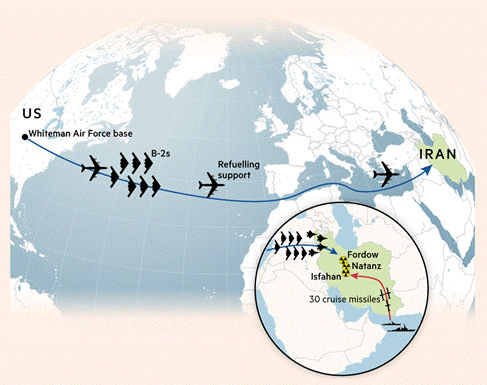
On the night between June 21 and June 22, 2025, the U.S. carried out Operation Midnight Hammer, striking Iran’s nuclear sites at Fordow, Natanz, and Isfahan. B-2 bombers dropped 14 GBU-57 bombs – 14-ton “bunker busters” capable of penetrating deep underground – twelve on Fordow, buried in the mountains, and two on Natanz. The Georgia submarine launched 30 cruise missiles at Isfahan, the third major site in Iran’s nuclear program. [1] Trump declared the operation had “completely and totally wiped out” Iran’s key uranium enrichment facilities. [2] However, Tehran vowed eternal revenge. Speaking from Istanbul, Foreign Minister Abbas Araqchi accused the U.S. of violating international law and said Iran was considering every possible response. [3]
It remains uncertain whether the U.S. strikes truly destroyed Iran’s nuclear facilities. No major radiation leaks have been detected, and IAEA Director Rafael Grossi said that even the Agency itself cannot yet assess the underground damage at Fordow. [4] The Pentagon reported significant – but not total – destruction. Tehran, on the other hand, claims it had anticipated the strikes and moved most of the sensitive material beforehand. Satellite imagery appears to support that version.[5]The White House recently rejected a leaked intelligence report by the Pentagon’s Defence Intelligence Agency suggesting that recent US strikes on Iranian nuclear sites only delayed Iran’s program by a few months. While dismissing the report as inaccurate and criticising the leak’s source, officials insisted the attacks were highly effective. President Trump echoed this stance, condemning the media coverage as false and reaffirming that the strikes “obliterated” Iran’s nuclear program. [6]
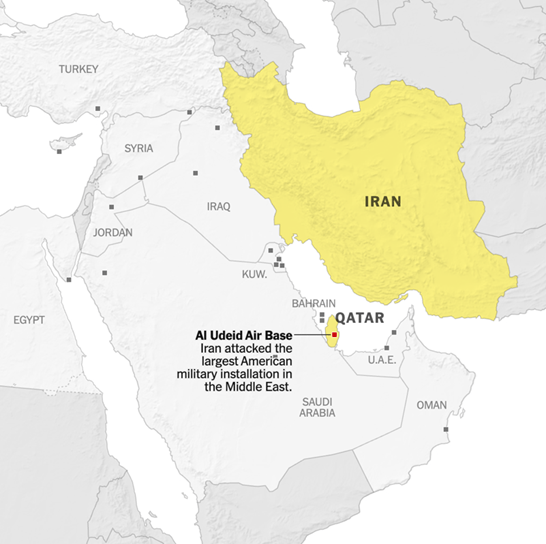
As expected, Iran launched retaliatory missile strikes on a U.S. air base in Qatar, almost two days after the American bombing. The attack was coordinated with Qatari officials and announced in advance to limit casualties. [7] It was a symbolic move aimed at simultaneously demonstrating resolve and restraint without triggering uncontrolled escalation – a message meant to preserve credibility while leaving the door open to diplomacy. This sequence of events led U.S. President Donald Trump to declare on Monday night that a “complete and total” ceasefire between Israel and Iran will go into force to end the conflict between the two nations.[8] Vice-President J.D. Vance emphasised Iran is incapable of building a nuclear weapon with current equipment, after the severe damages incurred.[9]
The next morning, Israel warned of new missile fire from Iran and vowed to retaliate, just minutes after it announced it had agreed to a US-brokered ceasefire with Tehran. However, Iranian state television then denied that the country had violated the ceasefire. US President Donald Trump has accused both Israel and Iran of violating the ceasefire. He later called on Israel to hold fire and not respond to an earlier reported Iranian missile attack. [10] A call Israel did not answer to, with reported attacks on the cities of Babolsar and Tehran. [11]
Following a conversation between U.S. President Donald Trump and Israeli Prime Minister Benjamin Netanyahu, Israel announced it would halt further attacks, but warned it would resume its assault if Iran attempted to restart its nuclear program.[12] At the same time, Iranian President Masoud Pezeshkian officially declared the end of the “12-day war”, confirming the ceasefire and affirming Tehran’s commitment to de-escalation, as long as Israel also upheld the truce.[13] Speaking at the NATO Heads of State and Government Summit in The Hague, Trump stated that American and Iranian officials are expected to hold talks next week, raising hopes for a more durable peace.
Background
Shortly after the June 13, 2025, attack, Trump remained silent. The only statement came from Secretary of State Marco Rubio, who called Israel’s action unilateral and denied any U.S. involvement. [14] Notably, it lacked the usual strong American backing for its ally. However, the next day, Trump praised the Israeli operation as a major success and urged Iran to reach a nuclear deal with the U.S., warning that future Israeli attacks could escalate. [15] This shift highlighted Trump’s opportunistic and bold approach.
It was increasingly evident that Trump was approaching a critical decision point: whether to turn Israel’s war into an American one by deploying U.S. forces, with serious internal and global repercussions. Trump had pledged to be a peace president, opposed to new wars. The possibility of intervention in Iran was dividing the Republican Party, especially the MAGA base, which had backed him as a staunch isolationist.[16]
Intelligence Assessment
What made Trump change his mind? As the effectiveness of Israel’s military operation became increasingly evident, Trump began to align more openly with Benjamin Netanyahu’s government, appearing eager to claim that “success” as his own. Until then, his foreign policy – from tariffs to Ukraine and Gaza – had largely proven ineffective or even counterproductive. There is also a personal dimension: Trump’s deep temptation to be remembered as the man who finally crushed the Iranian nuclear threat, succeeding where Bush, Obama, and Biden all failed, even at the cost of abandoning his isolationist principles.
Trump’s broader vision, however, goes beyond stopping Iran’s nuclear ambitions. He seeks to reshape the Middle East around another key strategic ally, Saudi Arabia, the country that stands to gain the most from dismantling Iran’s nuclear program. Notably, Crown Prince Mohammed Bin Salman responded to both the American and Israeli attacks by expressing solidarity, while also extending a hand to Iran.[17] In the language of the Gulf, this signals a recognition of Iran’s growing weakness and a bid to assert a new leadership role. Trump’s “new Middle East” plan aims to integrate the energy resources of the Sunni world with Israeli technology to form a bridge between South Asia, Western Europe, and North America – a so-called “Cotton Road”, positioned as a strategic alternative to China’s Belt and Road Initiative.
Trump’s campaign promise to end “endless wars” specifically targeted foreign interventions involving the deployment of American ground forces, such as those in Iraq and Afghanistan. While no troops have been deployed under his administration in this context, the U.S. has simultaneously maintained and reinforced its global influence through a policy framework emphasising “peace through strength.”[18] This enhances American deterrence, marking the start of what J.D. Vance defined as the era of “new Trump foreign policy doctrine,” and reflects a new model of projecting power worldwide, different from past approaches, but one that will likely still foster divisions within the Republican electorate. [19]
Following the operation, the United States signalled a willingness to return to diplomacy. However, Donald Trump, before announcing the ceasefire, once again raised the prospect of regime change in Iran, contradicting his administration’s stated aim of limiting the mission to halting Iran’s nuclear program. [20] The risks of such a scenario, however, are extremely high. A regime change in Tehran is unlikely to convey positive developments for the West. Eliminating the regime would have almost certainly pulled the U.S. and Israel even deeper into the conflict. Latest declarations from President Trump support this intuition, as he publicly distanced himself from pursuing regime change in Iran, emphasising a preference for stability and calm, amid pushback from MAGA supporters about the possibility of deeper U.S. involvement in the Middle East. [21]
Strategic Implications
Among possible future scenarios, a global escalation remains by far the most remote. It is, in fact, very unlikely that countries like Russia or China would go to war with the U.S. in response to its attack on Iranian nuclear sites. Neither is particularly displeased by the elimination of Iran’s nuclear program. While they may express formal opposition to the strikes, the reality is that no nuclear power welcomes the addition of a new member to the atomic club. Likewise, Sunni-majority countries in the Middle East, which include nearly all of them, are unlikely to protest.
It was very unlikely to imagine that Iran would not respond at all to an American strike on its most sensitive nuclear sites. However, it was likely that any such response would be carefully calibrated to avoid full-scale escalation, very likely including direct or indirect advance notice to Washington. Following Iran’s response, Trump publicly thanked Tehran for the warning and urged it to return to the negotiating table, making a short-term de-escalation more likely than not, and later confirmed it with the announcement of a complete ceasefire. [22] Further U.S. involvement now seems remote, and plausible only if the damage to Iran’s nuclear facilities turns out to be far less severe than the Pentagon hopes. Even in that case, any follow-up operation would likely follow the same limited model as the first one.
With the ceasefire announcement, the closure of the Strait of Hormuz remains very unlikely, also considering it would primarily harm China, Iran’s key partner, and would further isolate Tehran both economically and diplomatically. Last Sunday, Iran’s parliament unanimously approved a proposal to close the strait. [23] Blocking it would undoubtedly trigger a major global energy and inflation crisis. However, the decision is not yet final. The ultimate authority lies with the Supreme National Security Council and with Supreme Leader Khamenei himself.
The possibility of Iran deliberately targeting Americans, hoping to provoke a MAGA domestic backlash and force the U.S. to pull back, has always been remote. Trump had every reason to avoid it and could steer the situation by signalling restraint to Tehran. Moreover, Iran is a Shiite theocracy, not a Sunni one. The terrorist groups that have attacked the West, like al-Qaeda, ISIS, Boko Haram, and others, are all Sunni. Shiite militias, while armed, have no tradition of jihadist attacks in the West and lack the global, ideological drive of Sunni Salafism.
Risk assessment remains essential, particularly in light of recent statements from the Islamic Revolutionary Guard Corps (IRGC) suggesting that, in the event of Supreme Leader Khamenei’s departure, the IRGC could assume a more dominant role. Notably, the IRGC has interpreted the United States’ “Midnight Hammer” operation as indicative of a frontline military posture. [24] Should the ceasefire fail to hold, a significant escalation involving direct U.S. military engagement appears unlikely in the short term, constrained by both domestic political factors and broader strategic calculations. However, absent effective de-escalation mechanisms, the conflict risks evolving into a protracted and multifaceted regional confrontation.
Over the longer term, the main issue will be the real impact of the strikes on Iran’s nuclear proliferation capabilities. Iranian leaders will very likely support the theory that only nuclear weapons can truly protect them and soon resume efforts to develop them, despite Vance’s declarations. Iran is a country with substantial nuclear expertise, and recent domestic parliamentary approval of a plan to suspend commitments under the Nuclear Non-Proliferation Treaty and cease co-operation with the IAEA raises doubts about Iranian compliance.[25]
Conclusion and recommendations
The 12-day war exposed the fragile balance of power in the Middle East and the limits of military escalation as a path to stability. The United States intervened forcefully yet selectively, aiming to prevent nuclear proliferation without becoming entangled in another prolonged war. While the ceasefire reflects a moment of strategic pause, underlying tensions remain unresolved. Iran’s nuclear ambitions, Israel’s security doctrine, and America’s shifting foreign policy all point to a region still on the edge. For now, diplomacy holds, but it rests on uncertain ground, and the next miscalculation could turn containment into confrontation. Just like in Vietnam, Afghanistan, and Iraq, history now risks repeating itself in Iran, should the fall of the regime trigger the country’s implosion.
[1] Roque, Ashley. “Operation Midnight Hammer: How the US Conducted Surprise Strikes on Iran.” Breaking Defense (blog), June 22, 2025. https://breakingdefense.com/2025/06/operation-midnight-hammer-how-the-us-conducted-surprise-strikes-on-iran/.
[2] Stewart, Phil, Steve Holland, and Phil Stewart. “Trump Says Iran’s Key Nuclear Sites ‘obliterated’ by US Airstrikes.” Reuters, June 22, 2025, sec. Middle East. https://www.reuters.com/world/middle-east/iran-israel-launch-new-attacks-after-tehran-rules-out-nuclear-talks-2025-06-21/.
[3] Hernandez, Joe. “Iran’s Top Officials Condemn U.S. Strikes and Assert Their Right to Self-Defense.” NPR, June 22, 2025, sec. Middle East conflict. https://www.npr.org/2025/06/22/nx-s1-5441695/irans-top-diplomat-says-it-reserves-all-options-for-self-defense-following-u-s-strikes.
[4] “IAEA Director General’s Introductory Statement to the Board of Governors.” Text, June 23, 2025. https://www.iaea.org/newscenter/statements/iaea-director-generals-introductory-statement-to-the-board-of-governors-23-june-2025.
[5] Landay, Jonathan. “Satellite Images Indicate Severe Damage to Fordow, but Doubts Remain.” Reuters, June 23, 2025, sec. Middle East. https://www.reuters.com/world/middle-east/satellite-images-indicate-severe-damage-fordow-doubts-remain-2025-06-22/.
[6] Cohen, Natasha Bertrand, Katie Bo Lillis, Zachary. “Exclusive: Early US Intel Assessment Suggests Strikes on Iran Did Not Destroy Nuclear Sites, Sources Say | CNN Politics.” CNN, 24 June 2025, https://www.cnn.com/2025/06/24/politics/intel-assessment-us-strikes-iran-nuclear-sites.
[7] Staff, Al Jazeera. “Iran Attacks US Air Base in Qatar: What We Know so Far.” Al Jazeera. Accessed June 23, 2025. https://www.aljazeera.com/news/2025/6/23/iran-attacks-us-air-base-in-qatar-what-we-know-so-far.
[8] Singh, Kanishka, Andrew Mills, Parisa Hafezi, and Kanishka Singh. “Trump Announces Israel-Iran Ceasefire.” Reuters, June 23, 2025, sec. Middle East. https://www.reuters.com/world/middle-east/trump-announces-israel-iran-ceasefire-2025-06-23/.
[9] The Independent. “Trump Claims Israel and Iran Ceasefire: Vance Says ‘They Don’t Want to Keep Fighting,’” June 23, 2025. https://www.independent.co.uk/news/world/americas/trump-iran-israel-cease-fire-us-b2775543.html.
[10] Provan, Sarah, et al. “Israel-Iran Latest: Donald Trump Warns Israel to Hold Fire against Iran.” Financial Times, 24 June 2025, https://www.ft.com/content/f44016f4-25b7-4f3f-9bb2-613e5a6d9e5e.
[11] Israel Iran War Live: Iran Reports Attacks despite Trump’s Ultimatum to Israel. https://www.msn.com/en-in/news/world/israel-iran-war-live-iran-reports-attacks-despite-trumps-ultimatum-to-israel/ar-AA1HjR0x.
[12] “Stop Everything”: Trump Raised Voice at Netanyahu in Tense Call over Calling off Airstrikes. https://www.msn.com/en-us/news/world/stop-everything-trump-raised-voice-at-netanyahu-in-tense-call-over-calling-off-airstrikes/ar-AA1HldtR.
[13] Iran President Announces “end of 12-Day War” | The Times of Israel. https://www.timesofisrael.com/liveblog_entry/iran-president-announces-end-of-12-day-war/.
[14] House, The White. “Statement from Secretary of State Marco Rubio.” The White House, June 13, 2025. https://www.whitehouse.gov/briefings-statements/2025/06/statement-from-secretary-of-state-marco-rubio/.
[15] POLITICO. “Trump Embraces Israel after ‘Successful’ Iran Attack,” June 13, 2025. https://www.politico.com/news/2025/06/13/trump-israel-attacks-praise-interviews-00405303.
[16] Bradner, Eric. “MAGA Movement Divided over Trump’s Move to Bomb Iran | CNN Politics.” CNN, 22 June 2025, https://www.cnn.com/2025/06/22/politics/maga-movement-divided-trump-iran.
[17] Al Arabiya English. “Saudi Crown Prince Holds Talks with Regional, World Leaders amid Iran Crisis,” June 22, 2025. https://english.alarabiya.net/News/middle-east/2025/06/22/saudi-crown-prince-holds-talks-with-regional-world-leaders-amid-iran-crisis.
[18] House, The White. “WHAT THEY ARE SAYING: President Trump’s Display of Peace Through Strength.” The White House, June 22, 2025. https://www.whitehouse.gov/articles/2025/06/what-they-are-saying-president-trumps-display-of-peace-through-strength/.
[19] J.D. Vance Defines the ‘Trump Doctrine.’ https://www.msn.com/en-us/news/opinion/jd-vance-defines-the-trump-doctrine/ar-AA1Hn0sQ.
[20] “Trump Speculates about Iran Regime Change after US Strikes,” June 23, 2025. https://www.bbc.com/news/articles/cp8m3861637o.
[21] Gangitano, Alex. “Donald Trump Backs Away from Talk of Iranian Regime Change.” The Hill, 24 June 2025, https://thehill.com/homenews/administration/5366093-trump-backs-away-from-leadership-turnover-in-iran-regime-change-takes-chaos/
[22] “Donald Trump Reacts to Iran’s Strike on US Base – Newsweek.” Accessed June 24, 2025. https://www.newsweek.com/trump-reacts-iran-missile-strike-us-base-qatar-2089620.
[23] Jie, Lim Hui. “Iran’s Parliament Backs Blocking Strait of Hormuz. Its Closure Would Alienate Tehran Further.” CNBC, June 23, 2025. https://www.cnbc.com/2025/06/23/irans-parliament-approves-blocking-strait-of-hormuz.html.
[24] Kurdistan24. “Iran’s IRGC: U.S. Has Entered Frontlines of Aggression.” Iran’s IRGC: U.S. Has Entered Frontlines of Aggression, 22 June 2025, https://www.kurdistan24.net/en/story/847462/slug.
[25] Bozorgmehr, Najmeh. “Iran’s Parliament Votes to Halt Co-Operation with Nuclear Watchdog.” Financial Times, 25 June 2025, https://www.ft.com/content/b822152b-d0a4-4bff-83d5-a79afd88314e.
 Osservatorio Strategico Mediterraneo Allargato