

Key Takeaways
➢ Israel commits to the Druze minority in Syria, fostering economic aid, which is likely to be a strategic decision to get support from the ethnic minority during the post-Assad transitioning government.
➢ Iran is likely to perceive the Israeli protection of the Druze as a threat to its military projects in Southern Syria.
➢ During both the Assad regime and the current transitioning one, Türkiye aims to be involved into the Syrian decision-making process. Therefore, it is very likely to oppose Israeli advancements in the region, but not with a direct confrontation due to national turmoil.
➢ Lebanon is likely to oppose Israel increasing ties with the Druze if Israel continues with strikes in Southern Lebanon.
➢ Israel’s reverse periphery doctrine is very likely to be successful and strengthen regional alliances in the Eastern Mediterranean. However, neighboring states also play a crucial role in this process. Considering the ongoing crises that are shaping the Mediterranean geopolitical landscape, it is extremely important to monitor the role of each state with Israel.
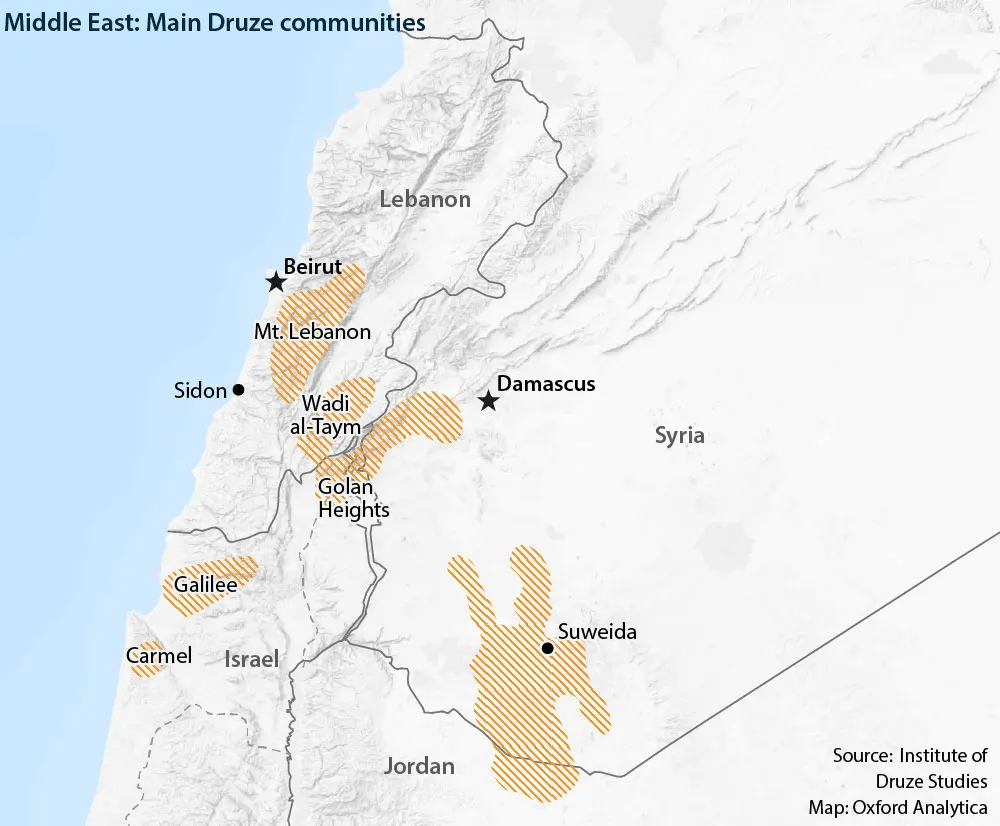
Source: http://www.druzestudies.org
Latest Development
Since February 23, 2025, Israeli Prime Minister Benjamin Netanyahu has publicly reported his intentions regarding the protection of the Druze population residing in Syrian cities. In his speech, Netanyahu demanded the demilitarisation of Southern Syria, explicitly saying that Israel will not allow any forces of the Hay ‘at Tahrir Al-Sham (HTS) to enter Damascus. Furthermore, he added that Israel will not tolerate any threat to the Druze minority in those areas.[1]
Along the same lines, on March 9, 2025, Israel passed, for the first time, a five-year plan (amounting to $1.1 billion) mainly aimed at resolving housing issues but also alleviating economic uncertainty for the Druze in what the Israeli authorities now regard as Northern Israel.[2]
Background
Historically, the state of Israel has been known for implementing a periphery doctrine with non-Arab countries to ensure support from buffer states. However, as Dr. Guzansky explained, Israel is now opting for a reverse periphery doctrine, through which it aims to form alliances based on concrete and mutual benefits with Arab Gulf countries and Eastern Mediterranean countries to face the rising power of Iran and Türkiye.[3]
Israel mainly targets ethnic minority groups such as the Druze and Kurds in several locations. These two groups play very different roles in the geopolitical scenario. Therefore, this briefing will only assess the role of the Druze in relation to Israel.
One area in which Israel is particularly active is the Golan Heights, which has beenrecognised by the International law as an occupied territory of Syria since 1967, although Syria never claimed it since the aftermath of the Six-Day War. After the fall of the Assad regime in Syria (December 2024), Israel fostered its occupation of Golan Heights by improving services in the existing settlements.[4]
The Druze make up approximately 4% of Syria’s population, 4.5% of Lebanon’s, 0.2% of Jordan’s, and 1.6% of Israel’s.[5]A significant number of Druze also reside in the Golan Heights. The Druze in Israel mainly identify as Syrian Arab citizens. At the same time, 20% of Golan Druze hold Israeli citizenship.[6]
There appears to be a strategic interest on the part of Israel in protecting the Druze minority. Unlike other ethnic minorities during the Assad regime, the Druze were neither active supporters nor rebels of the government; instead, they always neutrally claimed their independence. Therefore, during this transitioning period, the Druze face the rise of the Islamist government in Damascus, which does not include or recognize religious and ethnic minorities. Strategically, Israel aims to gain Druze support through interventions like the one in Jaramana, where Netanyahu threatened to send forces to protect the Druze.[7]
Intelligence Assessment and Strategic Implication
Recent continuous attacks in the Gaza Strip influence predictions about Israel’s evolving periphery doctrine. Before March 17, 2025, when Israel officially violated the ceasefire negotiations with Hamas, it was likely that Israel would annex additional Syrian territories beyond the Golan Heights. Now, due to international pressures, this seems unlikely. However, it is very likely that Israel will continue deepening its relations with the Druze. Indeed, the five-year plan is undoubtedly a signal of long-term commitment rather than a short-term one. Furthermore, Israel is also using lower-cost signals to ensure Druze support among local communities. After more than 50 years, a group of Druze religious elders entered Israel to meet the spiritual leader – a political move to establish ties between the Druze and Israel against the newly formed Syrian government.[8] Netanyahu’s strategies significantly influenced other neighboring states: Iran, Türkiye, and Lebanon. The three states have had longstanding relations with Syria since the Assad regime. Lebanon is also one of the states in which the Druze reside, making it peculiar for Israel to take a calculated risk in its regard during this time of instability.
- Iran is very likely to perceive the protection of the Druze as a threat to its expansionary military projects beyond its borders. During the Assad regime, the Islamic Republic of Iran took active efforts to keep Assad in power. Indeed, Iran mobilised the Islamic Revolutionary Guard Corps (IRGC) into expeditionary training missions.[9] According to the path dependency theory, a similar scenario is very likely to escalate into disagreements, with Israel supporting the Syrian ethnic minority.
- Recent protests following the arrest of the Istanbul mayor Imamoglu make a direct confrontation with Israel very unlikely. However, it is very likely that Türkiye will use diplomatic channels and soft power to condemn Israeli engagement with the Druze. Türkiye plays a similar role to Iran in Israel’s reverse periphery doctrine. Türkiye played a leading role in dismantling the Assad regime; therefore, President Erdogan is now heavily involved in shaping the new transitional government. Furthermore, Türkiye has a longstanding relationship with Syrian rebels due to its border with Idlib, granting them international aid and security.
- Turkish politicians are now motivated to establish a more inclusive Syrian government that recognises and protects ethnic minorities.[10] Indeed, it is almost certain that Israel’s plans do not align with Turkish interests. Nevertheless, Türkiye has a strategic advantage that prevents it from stepping back. The EU and the USA eased sanctions on Syria, making it more manageable for Türkiye to provide economic aid. Despite the five-year plan, the same cannot be said for Israel due to international pressures.
- Lebanon has been another target of Israeli air strikes in recent days. Although Israel declared its intention to target Hezbollah in Southern Lebanon, civilian casualties raised concerns of a new war.[11] Negative implications for Israel are expected since Lebanon is one of the countries where the Druze reside. The Times of Israel already reported comments from Lebanese Druze veterans, warning free Syrians to be cautious of Israel and accusing Israel of creating chaos and division in the country.[12] Therefore, the Druze in Lebanon are likely to distance themselves from Israel if military operations escalate further. Consequently, Lebanon is likely to experience internal instability between the Druze population and Israeli forces at the border. Fostering a sense of shared ethnic identity, both Druze residing in Syria and Israel are very likely to react against Israel, undermining efforts to establish support and cooperation so far.
Conclusion
Ties between the Druze and Israel will likely redefine regional dynamics. Given the unstable government in Syria, it is very likely that Netanyahu’s government will continue to deepen connections with the ethnic minority to expand Israeli power. The literature suggests that the reverse periphery doctrine has been used by Israel for a very long time, but now it is almost certain that such connections can strengthen reverse periphery doctrine. However, the ongoing conflicts in Gaza and Southern Lebanon put at risk the Israeli reputation, not only among the international community, but also among the Druze and other ethnic minorities, who are very likely to react. States like Iran, Türkiye, and Lebanon also have their interests in Syria and with the Druze. Therefore, it is likely that they will obstruct Israeli interventions at different degrees and engagement levels.
[1] Middle East Monitor. “Israel Seeks to Employ Druze from Syria,” February 25, 2025. https://www.middleeastmonitor.com/20250225-israel-seeks-to-employ-druze-from-syria/
[2] Freiberg, Nava, and ToI Staff. “Cabinet Okays NIS 4 billion Plan to Boost Country’s Druze, Circassians over 5 Years https://www.timesofisrael.com/cabinet-okays-nis-4-billion-plan-to-boost-countrys-druze-circassians-over-5-years/
[3] Guzansky, Yoel. “Israel’s Periphery Doctrines: Then and Now.” Middle East Policy 28, no. 3–4 (2021): 88–100. https://doi.org/10.1111/mepo.12579
[4] Middle East Eye. “What Is the Golan Heights?” https://www.middleeasteye.net/video/what-golan-heights
[5] Worlddata.info. “Druze – Worldwide Distribution https://www.worlddata.info/religions/druze.php
[6] Shomrim, Fadi Amun in partnership with. “Taboo No More: One in Five Golan Druze Now Holds Israeli Citizenship.” https://www.timesofisrael.com/taboo-no-more-one-in-five-golan-druze-now-holds-israeli-citizenship/
[7] “Syria’s Druze Seek a Place in a Changing Nation, Navigating Pressures from the Government and Israel | AP News.” https://apnews.com/article/syria-druze-damascus-alsharaa-sweida-war-ace48a6e138dc1197cca77c3d25d829b
[8] “Druze Religious Elders from Syria Make Historic Visit to Israel | Reuters.” https://www.reuters.com/world/middle-east/druze-religious-elders-syria-make-historic-visit-israel-2025-03-14/
[9] Institute for the Study of War. “Institute for the Study of War http://dev-isw.bivings.com/
[10] Aydıntaşbaş, Aslı. “Topple, Tame, Trade: How Turkey Is Rewriting Syria’s Future.” ECFR, February 6, 2025. https://ecfr.eu/article/topple-tame-trade-how-turkey-is-rewriting-syrias-future/
[11] Al Jazeera. “Lebanon Warns of ‘New War’ as Israel Launches Fresh Deadly Strikes.” https://www.aljazeera.com/news/2025/3/22/lebanon-warns-of-new-war-as-israel-launches-fresh-deadly-strikes
[12] Agencies and ToI Staff. “Prominent Lebanese Druze Leader Says He’ll Visit Syria amid Tensions with Israel.” https://www.timesofisrael.com/prominent-lebanese-druze-leader-says-hell-visit-syria-amid-tensions-with-israel/
 Osservatorio Strategico Mediterraneo Allargato