

Written by: Alessandro Maria Brenci & Sebastiano Ravetta
Key Takeaways
➢ Türkiye will almost certainly increase its military presence in Syria further.
➢ Israel almost certainly intends Türkiye’s air defence systems deployment as a threat to its strategic depth and operational air freedom. Israel will almost certainly continue to target military infrastructures in Syria.
➢ The deployment of a comprehensive Turkish layered air defence over the base remains unlikely.
➢ Israel-Türkiye diplomatic relations will almost certainly remain formal, while the tone will very likely worsen.
The Latest Event
On April 1st, 2025, The Jerusalem Post, quoting a Western intelligence officer, reported that Ankara “wants to become Syria’s air defense provider” and intends to accomplish this strategic objective “by establishing a presence at the T4 base, which was active during Assad’s regime.”[1] On April 3, 2025, the Israeli Air Force carried out airstrikes in Syria, also targeting the T4 air base, likely as a show of intent.
The latest Israeli attacks follow the path established since the fall of the Assad regime. Tel Aviv has struck multiple military and industrial facilities, “trying to stop weapons from landing in the hands of extremists,” notably the new transitional government.[2]
Background
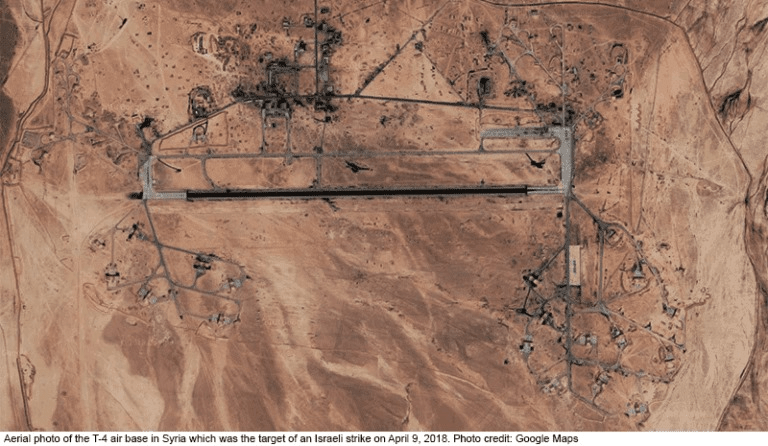
According to The War Zone, Türkiye has already begun the first stages of taking control over the base following the Russian withdrawal after the collapse of Bashar al-Assad’s regime.[3] Due to its position in the center of Syria, located in the Homs Governorate, the T4 base is considered a high-value military object, potentially granting access to most of the Syrian territory.
Besides its strategic position, the base is close to vast gas reserves that supply Syria’s primary thermal power plants.[4] Consequently, already in 2015, the Islamic State tried to seize control over it, but the regime was able to keep it.[5] The base also caused tensions in 2018 when the Israeli Defence Forces (IDF) accused Iran of using the base to supply Hezbollah and facilitate actions against Israel on the Lebanon border. The Syrian Free Army, backed by Ankara, conquered the base in December 2024.
On the night of March 21, 2025, the IDF conducted airstrikes in the region, justified by the presence of weapons and the necessity to maintain Tel Aviv’s strategic depth and operational air freedom in the delicate transitional period post-Assad.
According to the Middle East Eye, Turkiye is ready to position Hisar-type air defence systems as an instrument of deterrence.[6] Some sources suggest that Turkey aims to deploy a layered air defence based on improved SAM and radar systems, possibly deploying the Russian-made S-400. However, it remains very unlikely due to the Russian approval required for such deployment. Furthermore, the base will be restructured “to deploy surveillance and armed drones, including those with extended strike capabilities.”[7]
Intelligence Assessment & Strategic Implications
- Türkiye will almost certainly increase its military presence in Syria further. As the March 27, 2025, declarations of the Turkish MoD point out, Ankara is determined to become a major actor in the Middle East, and it will very likely have to deal with Israel.[8]
- Türkiye will very likely seek different options if plans related to the T4 base are stopped. Air bases near Aleppo, Hama, Homs, and even areas close to Damascus are reportedly being considered. According to The War Zone, citing the North Press Agency, Türkiye has begun reconstructing the Menagh Military Airbase close to Aleppo, northwestern Syria, coupled with an air defence centre.[9]
- Türkiye is very likely to use the new base in Syria to continue its fight against the Islamic State (IS) because the United States has made it a non-negotiable condition for their eventual withdrawal from the region.[10] Furthermore, Ankara will almost certainly continue to sustain Syrian territorial integrity to avoid the creation of independent area control by the Kurdish militia. At the moment, this is a remote possibility due to the signing of an agreement between the new Syrian government and the Syrian Democratic Forces (SDF), who have “hand(ed) over control of the region’s border posts, airport, and vital oil and gas fields.”[11]
- Israel will almost certainly continue to attack military infrastructures in Syria while avoiding reaching a breaking point with Ankara to protect its interests north of its borders. Therefore, diplomatic relations will almost certainly remain formal, but the tone of declarations is very likely to worsen.
- It is unlikely that such deployment will significantly impact Israeli capabilities to strike the Syrian territory. In contrast with other assessments, integrating these SAM platforms will very unlikely grant a de facto air superiority over central Syria. At the same time, it will likely impose a moderate to high degree of restrictions on hostile air activity. This deployment has to be intended as a deterrent to further Israeli attacks.
- Iran and the Russian Federation will very likely be excluded from this opposition, having lost their ‘boots on the ground.’ The Kremlin is still negotiating the possibility of keeping the use of military bases in Syria. Hence, Moscow will very likely consider moving its troops to another country to maintain its foreign projection in Africa, particularly Sahel.
Conclusion
The new regional dynamics that arose from the collapse of Bashar al-Assad’s regime are affecting Israeli-Turkish relations and the broader regional balance. Diplomatic relations between Ankara and Tel Aviv are expected to remain formal, but the tone of their declarations is likely to deteriorate.
Recent events involving the T4 military airbase highlight Ankara’s strategic objectives over Syria while also highlighting Tel Aviv’s reluctance to accept a stronger Turkish presence in the country. However, it is highly likely that Turkey will increase its military presence in Syria, supporting its territorial sovereignty and trying to grant a military shield to Israel’s incursion. Any significant development of Syrian capabilities is likely to be seen as an existential threat by Israel, making almost certain the continuation of bombing over military targets, with an eventual deployment of SAM platforms a moderate to high degree of restrictions on hostile air activity.
[1] Amichai Stein, “Western intelligence source to ‘Post’: Turkey aims to activate the Syrian T4 air base,” The Jerousalem Post, April 1, 2025, https://www.jpost.com/middle-east/article-848349
[2] Justin Salhani and Simon Speakman Cordall, “Why is Israel attacking Syria?” Al jazeera, December 11, 2024, https://www.aljazeera.com/features/2024/12/11/israel-attack-syria-explainer
[3] Howard Altman, “Israel Craters Runway To Keep Turkey From Taking Over Syrian Airfield” https://www.twz.com/air/israel-craters-runway-to-keep-turkey-from-taking-over-syrian-airfield
[4] Tamilla Hasanova, “Media: Tiyas airbase exit marks turning point in Russia’s military presence in Syria,” Calkiber, December 18, 2024, https://caliber.az/en/post/media-tiyas-airbase-exit-marks-turning-point-in-russia-s-military-presence-in-syria
[5] “Fortress T4: An Airbase at War,” Bellingcat, June 29, 2015, https://www.bellingcat.com/news/mena/2015/06/29/fortress-t4-an-airbase-at-war/
[6] MEE correspondent and Ragip Soylu, “Turkey moves to take control of Syria’s strategic T4 air base: Sources,” Middle East Eye, April 1, 2025, https://www.middleeasteye.net/news/turkey-moves-take-control-syrias-strategic-t4-air-base-sources
[7] MEE correspondent, “Turkey moves,” Middle East Eye, April 1,2025.
[8] “Turkish Defense Ministry discusses F-35 process, Syria’s new government at press briefing” Türkiye Today, March 27, 2025. https://www.turkiyetoday.com/turkiye/turkish-defense-ministry-discusses-f-35-process-syrias-new-government-at-press-briefing-137105/
[9] Howard Altman, “Israel-Turkey Tensions Mounting Over Air Bases In Syria”, March 28, 2025. https://www.twz.com/news-features/israel-turkey-tensions-mounting-over-air-bases-in-syria
[10] Mee correspondent, “Turkey moves,” Middle East Eye, April 1,2025.
[11] David Gritten and Lina Sinjab, “Kurdish-led SDF agrees to integrate with Syrian government forces,” BBC, March 11, 2025, https://www.bbc.com/news/articles/cedlx0511w7o
 Osservatorio Strategico Mediterraneo Allargato