
Abstract
The evolving geopolitical landscape has underscored, more than ever since the fall of the Soviet Union, the central role of states and their spheres of influence in international affairs. The projection of political views and ideological values by States seeking an influential role in the international arena is built on the traditional tools of powers: Diplomacy, Information, Military and Economy (DIME). Russia has identified the African Continent, particularly regions such as the Sahel, North Africa, and Central Africa, as a central piece in its pursuit of renewed global leadership. This paper studies the different dimensions of its influence on the continent. The first section examines the Kremlin’s activities in different African regions using Diplomacy, Information and Economy tools, such as State visits, disinformation, like in Mali, and resource extraction agreements, mainly in Congo, Angola, and Zimbabwe. The paper then studies Military cooperation, through arms sales, joint exercises and the role of Private Military Companies (PMC), particularly the Wagner Group in Libya and Mali. The guiding thread is the understanding of how this presence has evolved and the factors driving its continued expansion.
Introduction
In the aftermath of the fall of the Assad regime and after 49 years of Russian use of the Tartus naval base and the Khmeimim airbase in Syria, the Kremlin has not yet discussed the situation with the new government in Damascus. Now, it does not appear that the new rulers of Syria, supported by Turkey, want to prevent the Russians from maintaining their outposts, which now serve primarily logistical functions following the defeat of their historical ally.[1] The potential loss of these bases would significantly impact Russian ambitions in the wider Mediterranean.
These two bases have different relevance for Russia. The Tartus base allowed the Kremlin to maintain a continuous presence in the Mediterranean and kept NATO countries’ navies on the alert to protect the alliance’s Southern flank. In August 2022, a small Russian naval squadron partially sailed up the Adriatic Sea and forced the Italian Navy to conduct a “search operation” and closely monitor the operation of the ships that then made their way back to the eastern Mediterranean.[2] The Khmeimim base, on the other hand, has a different strategic relevance, as it serves to project Moscow’s influence in the African continent. Losing control over the base would put in jeopardy “Russian logistics, resupply efforts, and Africa Corps rotations, particularly weakening Russia’s operations and power projection in Libya and sub-Saharan Africa.”[3]
The text aims to investigate how the Kremlin’s influence takes different forms and ranges from diplomatic and economic penetration to direct and indirect military presence. It is appropriate to note that Moscow is not the only European competitor seeking to assert its presence on the continent, but it is the only one that will be considered in the text.
The DIME approach, developed by the United States during the Cold War, is a strategy used in the grey zone “between peace and war where nations use a hybrid combination of conventional and unconventional actions to achieve national objectives.”[4] Russia employs this model in Africa, putting together typical elements of sovereign state power: Diplomacy, Information, Military, and Economics (DIME).[5]
Nowadays, some theories within military and academic circles stress the need for an evolution of this concept. In 2020, the idea of considering Finance, Intelligence and Law Instruments (FIL) as instruments of power was already very diffused in the sector, and many argued it was “time to transition from a DIME to DIME-FIL concept.”[6] For the purpose of this research, only the traditional four-letter DIME approach will be considered.
In the international arena, the political will and the ambition of a state can be projected beyond its national borders only when they are effectively protected. Traditionally, the powers necessary for the protection and projection were Diplomatic, Economic, and Military (DEM). After the Second World War, countries acknowledged the power of Information, which is difficult to measure and to fully understand but its pervasiveness and power are self-evident. This awareness marked the shift from DEM to DIME approach.[7]
This research aims to understand the growing influence of Russia in the African Continent and the areas in which it concentrates. Before proceeding, it is necessary to clarify and define the key element that will be analysed. When considering influence, the paper takes into consideration all types of influence, i.e. both soft and hard power, following the DIME approach. In international relations and political theory, hard power can be defined as the ability of a state “to coerce”, while soft power as the ability “to pursue” another actor to do something it wants or needs.[8]
The first section of this paper will explore the Russian presence in Africa, focusing on the use of soft powers such as Diplomacy, education and Information. In the same section, there will be a study of the Economic penetration, which falls into the hard powers category. Secondly, an entire section will investigate the Military cooperation between Russia and certain African countries, considering the different ways it is conducted. Lastly, in the conclusion, the text will summarise what has been discussed and highlight the key points of the Russian presence.
Diplomacy, Information and Economics
As previously said, this first part will deal with the DIE components of the DIME approach described in the introduction. The first paragraphs are related to Diplomacy and Information and will be followed by an Economic overview.
During the Soviet period, Moscow’s policy towards the global south was to “support, especially in the United Nations, anti-colonial struggles and decolonisation proposals and resolutions.”[9] When the Soviet system collapsed, African countries saw that “Moscow cut military aid, suspend credit lines, close diplomatic representations, shut down cultural centres and finally withdraw political support”.[10]
The Kremlin’s current anti-Western narrative and information campaign uses a similar approach “as an entry point to promote Russia’s economic agenda over that of Western countries with an active presence on the continent”.[11] It has been noted by many observers that “some African governments, such as South Africa, are moving closer to Moscow” and “this shift can be attributed to long-standing frustration with the failures of Western intervention.”[12]
One of the reasons behind this strengthening of diplomatic relations is the Kremlin’s effort to break the international isolation that Ukraine’s allies are trying to impose through economic sanctions, for example. Furthermore, Russia claims that the world is coping with “the lack of an alternative to a multipolar world order.”[13] During Vladimir Putin’s visit to Bejing in May 2024, both he and his Chinese counterpart confirmed “the need to promote a new world order based on multipolarity” and “to counter the influence of the United States and the West in the world, especially in the so-called Global South” where Russia is trying to become a key actor.[14]
It is now necessary to study the concrete steps towards making diplomatic relations stronger. Official visits are the most efficient way to show the close diplomatic ties between two countries, underlying “their willingness to collaborate on an array of issues of mutual interest”.[15]
The Russian Ministry of Foreign Affairs, Sergej Lavrov, in 2023, has visited Africa twice and held meetings in nine capitals, promoting “the view that Russia is an anti-imperialist force, instrumentalizing positive memories of Soviet support for various African wars of independence against exploitative Western colonialists.”[16] When accused of being incoherent and carrying on an imperialistic foreign policy itself, Russia answers that it has never “had colonies in Africa or elsewhere” and that “even the Russian Empire could not be described as imperial in the same way as Britain or France because Russians lived alongside their colonized subjects and intermarried.”[17] With these claims, Russia presents itself as a trustworthy partner for African countries.
The second tool that will now be considered is Information, which is linked to the anti-western narrative and memory diplomacy. Often this kind of narrative is accompanied by “disinformation campaigns to discredit pro-Western forces” in many countries, such as Libya, Sudan, Mali, Niger, and the Democratic Republic of Congo, which are just some of the 16 where the Council on Foreign Relations has identified disinformation campaigns as April 2022.[18]
Another instrument of soft power that Moscow is trying to employ after the fall of the Soviet Union is the education of African leaders and elites, which falls in the category of Information in the DIME approach. In 2008, with a presidential decree, the Russian President established the Rossotrudnichestvo (Federal Agency for the Commonwealth of Independent States, Compatriots Living Abroad, and International Humanitarian Cooperation) which is “an autonomous Russian federal government agency under the jurisdiction of the Russian Ministry of Foreign Affairs” and responsible for the scholarship abroad.[19] The Rossotrudnichestvo has eight centres in Africa, remaining a powerful and useful political instrument.[20] The example of this agency is pivotal to assess the fact that soft powers tools in Russia are state-owned and these kinds of institutions serve as a “powerful presence”, “championing supposedly oppressed Russian minorities abroad … [and] thundering against the alleged iniquities of Western policy.”[21] Concluding on this topic, it can be assessed that the Russian strategy, in this case, is on the long run and that it will continue “to invest in training young African leaders, considered as the bridge between Russia and Africa.”[22]
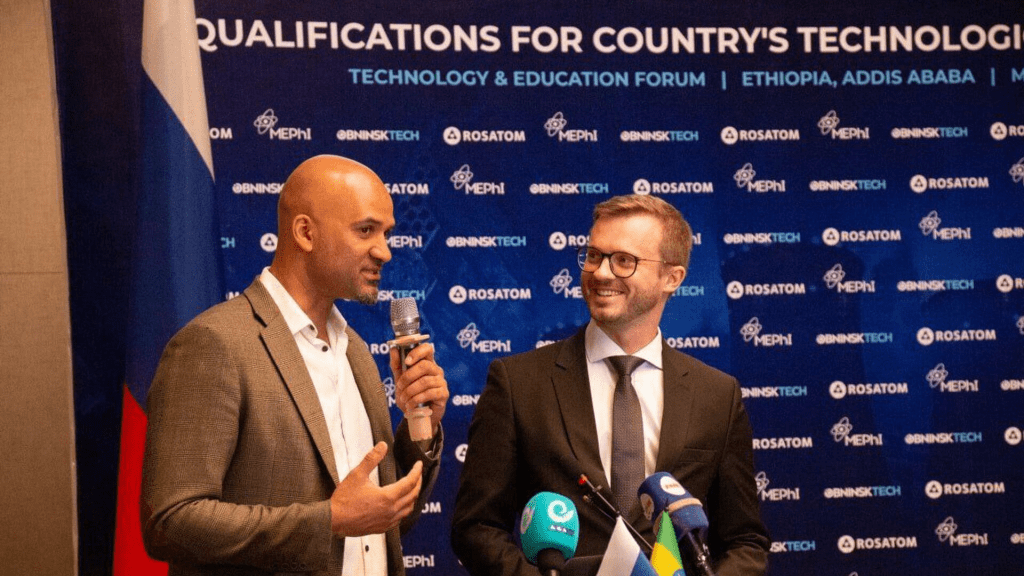
It is important to cite the case of Rosatom, the Russian nuclear energy company, because it conducts a double action, falling both under the Diplomatic/Informational side and the Economic side of DIME. Rosatom is the biggest constructor of nuclear reactors in the world, and it incorporates 450 enterprises, making it an enormous partially state-owned company. [23]It is an interesting case because the company combines both soft power efforts, founding “science, technology, engineering, and mathematics education programs”, offering “scholarships for Africans to study in Russia”, and hard power efforts, engaging in different African countries.[24]
Rosatom started building the first nuclear reactor in Egypt in 2022, underlying that Moscow’s “economic outreach to Africa is […] dominated by […] companies that are either partially or fully owned by the state, including oil and gas giants Rosneft, Tatneft, and Gazprom, which carry out major hydrocarbon projects in North Africa.”[25] Raw materials are at the centre of Russian economic action in Africa, too; another example of these partnerships and penetrations is Almora, a Russian mining company which has increased “its operations in Angola, Congo, and Zimbabwe.”[26]
Nevertheless, the Kremlin cannot be considered as a major actor from an economic point of view. Indeed, Moscow plays a limited role in Foreign Direct Investments (FDI) and bilateral trade.[27] Focusing on trade, Statista presents an increase from 2013 to 2023 in trade revenues between Russia and all African countries, growing from $9.9 billion to $24.6 billion.[28] Focusing on the main goods exchanged between the countries, we find that, together with grain, Russia “exports wheat, coal, refined petroleum, and electronics.”[29] In October 2019, Sochi (Russia) hosted the first Russia-Africa Summit which outlined Russian economic priorities in the African continent as follows:
“Energy, including renewables, infrastructure development and especially railway and housing construction, modern and high-tech extraction and processing of mineral resources, agriculture, digital technologies, oil and gas exploration, medicine, science and education.”[30]
In 2019, President Putin promised “to double trade with African countries to $40 billion in five years”. However, he has reached only half of this pledge. In the second edition of the Summit in 2023, the Kremlin promised “to wipe out debts worth $23 billion and announced military cooperation agreements with over 40 African countries.”[31]
After the first Summit, an article in the Washington Post reported the idea that Russia was “highlighting collaboration over aid, and that message is tempting to some leaders who view the West’s outreach as patronizing”.[32]
Despite the partial success of Russia’s promises in economic terms, their presence in some African states must be carefully studied and related to today’s global realities. With its agreements of extraction, the Russian Federation has secured access to valuable natural resources, such as gold, diamonds, and uranium, but critical minerals like cobalt and other rare earth elements (REEs).[33] These resources are highly necessary for modern industries, modern civil and military products and global supply chains. Therefore, the Russian economic footprint can be seen as more indirect because it does not focus on the traditional means of economic cooperation but rather on fields where it can provide the ‘know-how’ to the host countries and obtain lucrative agreements.
One important achievement obtained thanks to this renewed strategy, which incorporates the exploitation of any tool of the DIME spectrum, was at the emergency session of the United Nations General Assembly on March 2nd, 2022. On this occasion, the UNGA voted on a resolution condemning “in the strongest terms the aggression by the Russian Federation against Ukraine in violation of Article 2 (4) of the Charter”.[34] The resolution was adopted with 141 in favour of 193 members, thus raising the question of who was not condemning this ‘aggression’. Looking at the votes, it turns out that 26 countries in the African region decided to vote against, abstain, or not vote at all; showing that Russian isolationism is not global, but the political ties with these countries and others around the world are strong.[35] This example is proof of the succeeding efforts carried out by the Kremlin to tighten diplomatic relations in the region.
Military cooperation
In this second section, the present paper will discuss the complex military cooperation existing between Russia and certain African countries, which is the main tool that Moscow employs to get closer to African countries. The new pledge made by Putin in 2023 is a key element in this direction. The military cooperation is robust and articulated around different aspects, such as “arms sales, joint military training programs, and Russian Private Military Companies (PMC) activities.”[36]
The military penetration is a complex phenomenon which has changed over the years from the fall of the Soviet Union to nowadays. Russian military personnel have rarely participated actively in actions in Africa, it has been more often “supplemented by Russian PMC activities, which have been rather extensive on the continent.”[37] According to US Congress research, the deployment has been intensified around 2017, with “thousands of Russian security personnel” being deployed.[38]
Starting with the modest official military presence, President Putin underlined the different institutional sides of collaboration at the Summit in 2019. Putin argued that “the situation in many African regions remains unstable”, advocating for an expansion in joint efforts in the fight against terrorism, extremism and transnational crime, which is supported by the “training military personnel and law enforcement officers for African countries at specialised Russian institutions.”[39]In 2019, President Putin celebrated the increasing and successful military and technological cooperation, which allowed 30 countries to improve their combat capability and to be supplied “with a wide range of armaments and equipment.”[40]
President Putin disclosed two additional examples of cooperation. The first one is related to what has been previously discussed, education, as officials “from 20 African countries are studying at higher education institutions of the Russian Defence Ministry”[41]. The second one is an even more direct collaboration than the sales of weapons, with “African partners participate actively in Russia’s military forums and exercises, where they can see samples of up-to-date weapons and military equipment, and learn how to use it”.[42]
These examples presented by Putin highlight the complexity of military relations between the Kremlin and African states. Delving deeper into the trade of military materials, it is important to say that Russia is responsible for 40% of Africa’s weapons import, and it has increased its agreement with the sub-Saharan region, exacerbating existing tensions between governments and opposition movements.[43] Reports indicate a growing Russian presence in those countries that have witnessed a coup in recent years, like Burkina Faso, which is also the first country hosting a Russian military base on the continent.[44] In this regard, the Kremlin aims to close a deal with Sudan and build their first naval base in the Red Sea, permitting “Russia to station up to three hundred troops on the base and create a logistical supply point for military ships, including nuclear ones.”[45]
Alongside these institutional efforts, a significant role is played by PMCs, which operate in an opaque way and often blur the lines between state and private interests. The RAND Corporation has produced a report on Russian involvement in the African Continent and, after assessing the validity of different sources and reports dealing with the operations of PMCs, it has concluded “that there have probably been at least 34 Russian PMC operations in 16 African countries since 2005.”[46] Developing furthermore the analysis, the authors suggest that only 10% of these “activity across Africa included combat or other operational tasks beyond immediate self-defence, putting them in the category of mercenary operations.”[47]
The aim of this section is to delve into the military influence of the Kremlin and the RAND’s report helps in this direction, pointing out that only seven of these present weak links to the state, whereas all the other interventions have moderate[48] or strong[49] links to the Russian institutions. These results foster the thesis of a growing interference by Russian state actors. An important change related to Russian PMCs happened in August 2023, when the owner and leader of the Wagner Group, Yevgeny Prigozhin, died in a plane crash and the group transitioned into the present Africa Corps.
The reason for using the Wagner Group is that “the group serves as a politically ‘plausibly deniable’ force that can project Russian power at short notice and low cost while avoiding Russian military personnel casualties.”[50] Founded in 2014, the existence of the company has been under the radar for many years and its ties with the Kremlin were even more secretive.[51] After February 2022 the situation has changed and once Wagner mercenaries were seen fighting in Ukraine, many studies and research have been conducted, revealing that the company is not a simple mercenary group, but that its members closely align with the political views of Putin and that they use some of the facilities of the Ministry of Defence. It is not wrong, therefore, to affirm “that the group is not a traditional PMC, but rather a tool in President Putin’s unconventional or ‘hybrid’ military arsenal.”[52]
The Wagner group, and nowadays the Africa Corps, according to the report of the Rand Corporation report, have conducted multiple operations, among other states, in Mali and Libya.[53] Russian interventions in Africa can often be seen as opportunistic but, Mali, for example, has showed the “desire to build a new alliance with a partner that it perceives as stable and effective in managing insecurity and that has a force in place that can protect the current power structures.”[54] The intervention of the Wagner Group started around 2022, when the fragile Malian government asked the French to leave the country and aimed at “providing training and support to the Malian military, protecting strategic assets and infrastructure, and enhancing Russian soft power”.[55] These objectives are in line with the plan pointed out by President Putin, but failed to deliver on the third point, because it has been reported that Wagner supported Mali’s army in violating human rights, killing civilians, burning houses and kidnapping people.[56]
Turning the focus on a major field of action of Russia in Africa, it is necessary to consider Libya. The country has been divided since 2014 under two rival governments: the UN-recognized Government of National Unity, backed by Turkish militias in the West; and the Government of National Stability, supported by the Libyan National Army of General Khalifa Haftar, in the East.[57] The forces of Haftar were logistically supported by Wagner and after the death of Prigozhin, “Moscow has begun consolidating the Wagner Group’s operation in Libya under the direct control of the Main Directorate of the General Staff of the Russian Federation (GRU).”[58] The Russian presence in Libya pursues two objectives: one is economical and the second one is strategic.
In the first case, as stated by Tim Eaton, senior research fellow of Chatham House, the presence is aimed “to get access to oil revenues more or less indirectly supporting Haftar’s armed forces.”[59] This example provides us with a clear interconnection of the different spheres of the DIME approach. On the other hand, the Russian Defence Ministry sees Libya as “an important staging post for Russian operation in Sudan, the CAR, and the new military alliance of Sahel States, consisting of Niger, Mali, and Burkina Faso.”[60] Mister Eaton has defined Libya “as a bridgehead.” [61] This definition is backed by the Russian use of airbases at Al-Jufra, Sirte, and Brak al Shati, and a harbour raising question on a possible deployment of nuclear submarines.[62]
The Libyan case further highlights the Kremlin’s strategic need and ambition to secure a foothold in the Wider Mediterranean. The Syrian bases are likely to remain in Russian hands in the next years, but Moscow is assessing its priorities and differentiating its course of action to stabilize its presence in the African country.
Conclusion
Throughout this analysis, the presence of Russia in Africa has been broadly examined and described. First, Moscow articulates its presence with a comprehensive approach built on Diplomacy, Information, Military and Economy (DIME). These different tools are employed in synergy and, often, the same action is based on two of these tools. Second, this presence was in origin carried on for ideological purposes by the Soviet Union, but the Kremlin nowadays has been described more as opportunistic.
In the first part, it was shown how Russia has employed Diplomacy, education, and Information, to be able to get closer to certain key countries, especially in Sub-Saharan and Central Africa. Russian foreign Minister Lavrov, officials from the Defence Ministry and other governmental entities have visited Africa multiple times, after the outbreak of the war in Ukraine, to demonstrate that Russian Federation was not globally isolated, albeit the different votes held at UNGA are a written testimony of this phenomenon. Moscow also uses education as a soft power, granting scholarships to the African elite or hosting them directly in Russia to complete their education, mainly in military schools. Soft power is additionally employed by Russia large state-owned companies operating in the natural resources sector, which, on the one hand, fund schools and education programs. On the other hand, these companies are closing major deals allowing Russia to have alternatives to Western markets and, therefore, being able to avoid sanctions. The first section of this paper has highlighted the use of the Diplomatic, Informative and Economic parts of the DIME spectrum.
Russia is largely utilizing the tool of Military cooperation and sale of both lethal and non-lethal equipment to engage with African countries where the political situation is unstable, and the risk of conflict is very high. In the second section, the paper focuses on the Military aspect of the DIME approach, highlighting the centrality of this tool in the Kremlin’s strategy. Moscow employs, to a limited degree, institutional tools, preferring to implement PMCs’ activities in different countries across the Continent. The Wagner group, which was the principal PMC and is now under the control of the military intelligence, operating mainly in Libya and in the Sub-Saharan region.
Assessing the military presence in two countries, Libya and Mali, helped reveal the interplay of the different aspects of DIME. Russia engages in military support and disinformation in one country, but it has economic ambition in another one. Libya has been identified as a strategic bridgehead, ensuring a sustained military presence across the region in case the Syrian outpost is lost. It is important to note that operations in Libya began in 2018, meaning its role has been gradually reinforced rather than serving as a direct response to Assad’s regime fall.
In conclusion, it can be assessed that the Russian presence will increase further in the coming months based on the DIME approach. Diplomacy and Information will be used to break the international isolation, mainly in Europe, and to facilitate the actions of the Economic and Military tools. Especially sub-Saharan countries will be at the centre of these actions because of the presence of REEs, which will be progressively more and more valuable in global supply chains and the economy.
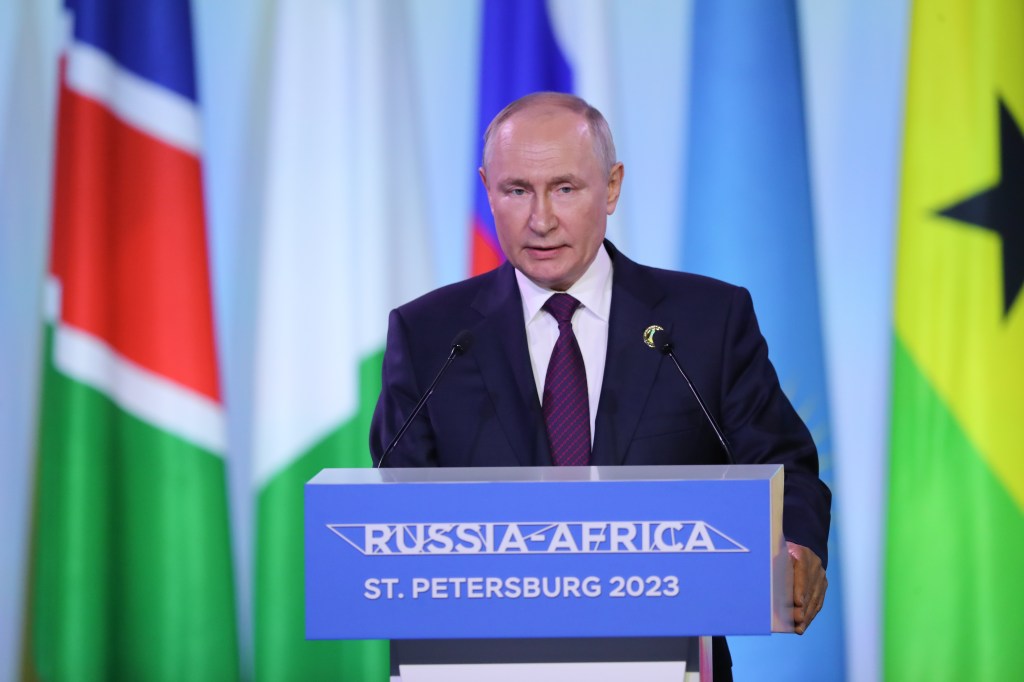
Cover image: Press statements by Vladimir Putin and Chairperson of the African Union, President of the Union of Comoros Azali Assouman. Photo by Anatoliy Medved
[1] “I Negoziati per Le Basi Russe in Siria,” Analisi Difesa,” February 5, 2025. https://www.analisidifesa.it/2025/02/i-negoziati-per-le-basi-russe-in-siria/.
[2]“Marina Militare: Il Confronto (Improponibile) Nell’Adriatico,” August 22, 2022
[3] Christina Harward et al, “Russian offensive campaign assessment,” Institute for the Study of War, updated on March 2, 2025, 7:45 pm (ET), https://www.understandingwar.org/sites/default/files/2024-12-08-PDF-Russian%20Offensive%20Campaign%20Assessment_0.pdf.
[4] Micheal McCarthy et al., “The gray zone,” in Deterring Russia in the gray zone, Strategic Studies Institute, US Army War College, 2019, 1, http://www.jstor.org/stable/resrep20099.6.
[5] T. Kodelle et al., “A general theory of influencing in a DIME/PMESII/ASCOP/IRC² Model,” Journal of Information Warfare 19, no. 2 (2020): 12–26, https://www.jstor.org/stable/27033618.
[6] Cesar Augusto Rodriguez, Timothy Charles Walton, and Hyong Chu, “Putting the ‘FIL’ into ‘DIME’: Growing joint understanding of Power,” Joint Force Quarterly 97, no.2 (2020): 121 – 128, https://ndupress.ndu.edu/Portals/68/Documents/jfq/jfq-97/jfq-97_121-128_Rodriguez-Walton-Chu.pdf?ver=2020-04-01-095603-607.
[7] Keith Slack, “The information Lever of Power,” Freeman Air & Space Institute, paper 10 (2019), https://www.kcl.ac.uk/warstudies/assets/information-lever-of-power.pdf.
[8] Ernest J. Wilson, “Hard Power, Soft Power, Smart Power,” The Annals of the American Academy of Political and Social Science 616 (2008): 110–124, 104, http://www.jstor.org/stable/25097997.
[9] Nikolai Fedorenko, “The Soviet Union and African Countries,” The Annals of the American Academy of Political and Social Science 354 (1964): 1–8, http://www.jstor.org/stable/1035313.
[10] Giovanni Faleg, and Stanislav Secrieru, “Russia’s forays into sub-Saharan Africa: Do You Want to Be My Friend, again?” European Union Institute for Security Studies (EUISS), 2020, http://www.jstor.org/stable/resrep25021.
[11] Dzvinka Kachur, “The Russian Approach to Africa,” in Russia’s Resurgence in Africa: Zimbabwe and Mozambique, South African Institute of International Affairs, 2020, http://www.jstor.org/stable/resrep29565.8, 14.
[12] Mariel Ferragamo, “Russia’s Growing Footprint in Africa,” Council on Foreign Relations, December 28, 2023, https://www.cfr.org/backgrounder/russias-growing-footprint-africa#chapter-title-0-9.
[13] Burç Eruygur, “Russia to Convey ‘no Alternative to Multipolar World Order’,” Anadolu Agency, February 10, 2025. Accessed February 16, 2025. https://www.aa.com.tr/en/europe/russia-to-convey-no-alternative-to-multipolar-world-order/3477638.
[14] Margarita Arredondas, “Russia and China Insist on a New ‘Multipolar’ World Order,” Atalayar, May 25, 2024, https://www.atalayar.com/en/articulo/politics/russia-and-china-insist-on-new-multipolar-world-order/20240522061000200393.html.
[15] Oasis Kodila-Tedika and Sherif Khalifa, “The Causes and Consequences of Official Diplomatic Visits: A Survey,” Research in Economics 78, no. 3 (June 3, 2024): 100978, https://doi.org/10.1016/j.rie.2024.100978.
[16] Jade McGlynn, “Russia’s Anti-Colonial Narrative Is Putin’s Diplomatic Strategy in Africa,” Foreign Policy, May 15, 2023, https://foreignpolicy.com/2023/02/08/russia-ukraine-colonialism-diplomacy-africa/.
[17] McGlynn, “Russia’s Narrative,”
[18] Ferragamo, “Russia’s Footprint,
[19] Kachur, “Russian Approach,” 15.
[20] Kachur, “Russian Approach.”
[21] Mark Galeotti, “Controlling chaos: how Russia manages its political war in Europe,” European Council on Foreign Relations, 2017,http://www.jstor.org/stable/resrep21563, 5.
[22] Kester Kenn Klomagah, “Russia Educating and Training Future African Leaders,” Modern Diplomacy, May 10, 2024, https://moderndiplomacy.eu/2024/05/11/russia-educating-and-training-future-african-leaders/.
[23] “About Us,” Rosatom, accessed February 18, 2005, https://rosatom.ru/en/about-us/.
[24] Paul Stronski, “Late to the Party: Russia’s return to Africa,” Carnegie Endowment for International Peace, October 16, 2019, https://carnegieendowment.org/research/2019/10/late-to-the-party-russias-return-to-africa?lang=en, 11.
[25] Mathieu Droin and Tina Dolbaia, “Russia is still progressing in Africa. What’s the Limit?” Center for Strategic & International Studies, CSIS, August 2023, https://www.csis.org/analysis/russia-still-progressing-africa-whats-limit, 4.
[26] Droin and Dolbaia, “Russia progressing,” 5.
[27] Ferragamo, “Russia’s Footprint,”
[28] “Trade revenue between Russia and African countries from 2013 to 2023,” International Trade, Statista, published June 12, 2023, https://www.statista.com/statistics/1063423/russia-and-african-countries-trade-volume/.
[29] Droin and Dolbaia, “Russia progressing,” 4.
[30] “News”, Summit Africa, October 2019, accessed February 19, 2025, https://summitafrica.ru/en/news/podvedeny-itogi-pervogo-sammita-i-ekonomicheskogo-foruma-rossija-afrika-roskongress-prodolzhit-rabotu-na-afrikanskom-treke-v-period-do-sledujuschego-foruma/.
[31] Alex Vines and Amare Tighisti, “Russia-Africa Summit fails to deliver concrete Results,” Chatam House, august 2, 2023, https://www.chathamhouse.org/2023/08/russia-africa-summit-fails-deliver-concrete-results.
[32] Danielle Paquette, “As the U.S. Looks Elsewhere, Russia Seeks a Closer Relationship With Africa,” Washington Post, October 26, 2019, https://www.washingtonpost.com/world/africa/as-the-us-looks-elsewhere-russia-seeks-a-closer-relationship-with-africa/2019/10/25/7e329124-f69e-11e9-b2d2-1f37c9d82dbb_story.html.
[33] Saptakee Sengupta, “Russia Power Plays: Deploys Military Might Over Africa’s Critical Minerals,” Carbon Credits, May 7, 2024, https://carboncredits.com/russia-power-plays-deploys-military-might-over-africas-critical-minerals/.
[34] UN General Assembly, Resolution ES-11, Aggression against Ukraine, A/RES/ES-11/1 (March 2, 2022), https://digitallibrary.un.org/record/3965290?ln=en&v=pdf.
[35] UN General Assembly, Resolution ES-11.
[36] Droin and Dolbaia, “Russia progressing,” 5.
[37] Droin and Dolbaia, “Russia progressing,” 6.
[38] Alexis Arief et al., “Russia’s Security Operations in Africa,” Congressional Research Service, Congressional Research Service, January 2, 2025, accessed February 23, 2025, https://crsreports.congress.gov/product/pdf/IF/IF12389#:~:text=The%20Wagner%20Group%20initiated%20missions,Africa%2C%20including%20military%20logistics%20facilities.
[39] “Russia-Africa Summit,” Transcript, President of Russia, October 24, 2019, 17:00, Sochi, http://www.en.kremlin.ru/events/president/transcripts/61893.
[40] “Russia-Africa Summit,” President of Russia.
[41] “Russia-Africa Summit,” President of Russia.
[42] “Russia-Africa Summit,” President of Russia.
[43] Selcan Karabektas, “Russia’s Growing Military Footprint in Africa: Arms Deals and Defense Cooperation,” Orion Policy Institute, August 30, 2024, https://orionpolicy.org/russias-growing-military-footprint-in-africa-arms-deals-and-defense-cooperation/.
[44] Karabektas, “Russia’s footprint.”
[45] Karabektas, “Russia’s footprint.”
[46] Adam R. Grissom et al., “Russia’s Growing Presence in Africa: A Geostrategic Assessment,” RAND Corporation, January 31, 2022, https://www.rand.org/pubs/research_reports/RR4399.html, 16.
[47] Grissom et al., “Russia’s Growing presence.”
[48] “Direct coordination with Russian state institutions and/or the presence of personnel who are senior reservists with elite units of the Russian security services”.
[49] “Direct authorization or funding of the operation by the Russian state (i.e., operating in Russian state interests) and/or evidence that the Russian PMC personnel have received training and weaponry directly from Russian government entities”
[50] Mohamedou Kemal, “The Wagner Group, Russia’s Foreign Policy and Sub-Saharan Africa,” Geneva Centre for Security Policy, GCSP Publication, March 6, 2024, https://www.gcsp.ch/publications/wagner-group-russias-foreign-policy-and-sub-saharan-africa, 10.
[51] Piotr Sauer, “Putin Ally Yevgeny Prigozhin Admits Founding Wagner Mercenary Group,” The Guardian, November 8, 2024, https://www.theguardian.com/world/2022/sep/26/putin-ally-yevgeny-prigozhin-admits-founding-wagner-mercenary-group.
[52] Kemal, “Wagner Group,” 11.
[53] Grissom et al., “Russia’s Growing presence.”
[54] Kemal, “Wagner Group,” 18.
[55] Kemal, “Wagner Group,”
[56] “Mali: Atrocities by the Army and Wagner Group,” Human Rights Watch, December 16, 2024, https://www.hrw.org/news/2024/12/12/mali-atrocities-army-and-wagner-group.
[57] David Ehl, “How the Russian Wagner Group is entrenching itself in Africa,” Deutsche Welle, October 27, 2024, https://www.dw.com/en/russia-kremlin-wagner-group-influence-in-central-african-republic-sudan-mali/a-70599853.
[58]Andrew McGregor, “Russian Military Intelligence Takes Over Wagner Operations in Libya,” Eurasia Daily Monitor Volume: 21 Issue : 38, The Jamestown Foundation, March 12, 2024, https://jamestown.org/program/russian-military-intelligence-takes-over-wagner-operations-in-libya/.
[59] Ehl, “Wagner entrenching in Africa.”
[60] McGregor, “Military takes over Wagner.”
[61] Ehl, “Wagner entrenching in Africa.”
[62] McGregor, “Military takes over Wagner.”

 Osservatorio Strategico Mediterraneo Allargato