
Abstract
The present publication explores Ethiopian foreign policy’s scarcely foreseen evolutionary trajectory under Prime Minister Abiy Ahmed’s transformative leadership and revolutionary liberal-inspired Medemer political agenda. It focuses on the ideological shift from its region-building and cooperation-oriented hegemonic ambitions to a more assertive and militarized approach post-2022, in the aftermath of the bloody Tigray war it inadvertently ignited. Once almost universally welcomed as a visionary statesman and Nobel Peace Prize recipient, Abyi Ahmed now faces a tarnished reputation jeopardising his self-centred foreign policy velleities. In particular, the article explores the interplay between domestic dynamics and foreign-policy realignments, analysing Ethiopia’s deteriorating relations with its neighbours and the rise of aggressive intra-power competition in the Horn of Africa. It also argues that Ethiopia’s path reflects the inherent fragility of personalized foreign policy strategies when detached from structural and historical constraints, providing broader lessons on the limits of transformational leadership in fragile states and defying previous theoretical conceptualizations.
“At its core, Medemer is a covenant of peace that seeks unity in our common humanity”
Abyi Ahmed, at the United States Institute for Peace[1]
Introduction
Assuming power in 2018, Ethiopian Prime Minister Abiy Ahmed established himself on the global stage as a charismatic young reformer with a comprehensive, transformative agenda, known by the name of his book manifesto[Ug1] [Ug2] , Medemer, from Amharic “synergy” or “cooperative engagement”.[2] Medemer envisioned foreign investment attraction and free-market economic restructuring to “ignite economic change across Africa” and constitutional amendments to dismantle the ethnic federalist system instituted by the ruling Ethiopian People’s Revolutionary Democratic Front (EPRDF).[3]
Regarding foreign policy, it signalled a significant break with the EPRDF’s foreign policy in terms of both style and vision, adopting an extremely personalised approach and pushing for never-before-seen regional economic and political integration.[4] With an unusually pragmatic attitude, it promoted dynamic engagement with neighbouring countries and newly forged partnerships while subordinating foreign policy to domestic issues to pursue internal power consolidation and legitimacy building.[5]
This new course initially appeared successful, receiving great praise from the Euro-Atlantic world. It culminated in the 2019 Nobel Peace Prize award to Abiy after the historic Ethiopia-Eritrea Summit ending their 20-year-long border conflict. Ethiopia was largely recognised as an “African powerhouse in the making”, and Abiy emerged as a regional peacemaker.[6]
Nevertheless, after six years, these aspirations diverge significantly vis-à-vis the harsh reality of Ethiopia’s current assertive international posture, the Horn of Africa’s rising instability and Abyi’s tarnished reputation. The aim of this publication is to explore post-2018 Ethiopian Foreign Policy developments, the causes of its abrupt change from 2022 and the subsequent deterioration of relations with most of the neighbouring countries. More specifically, it will examine the domestic politics-foreign policy nexus, emphasising Abiy Ahmed’s agency and assessing the role of the 2020-2022 Tigray War in derailing his projects for the region. While there is a relatively wide literature on Ethiopian foreign policy and region-building attempts, it lacks a coherent corpus on its determinants and developments from 2018, which this publication aspires to bridge by providing a comprehensive analysis of Ethiopia’s evolving strategic posture, key policy shifts and subsequent reverberations on the Horn of Africa and the Wider Mediterranean region.
Rupture with the past: Abyi’s brief moment of triumph 2018-2020
Under the previous EPRDF rule, foreign policy was seen as a tool to enforce the developmental state-led socio-economic project of the Meles Zenawi premiership, as exemplified by its programmatic 2002 White Paper on Foreign Policy and National Security. [7] Its main purpose was to ensure space for economic policy autonomy and domestic power consolidation, steering away from the then-dominant neo-liberal Washington consensus and IMF guidelines, and guaranteeing economic independence.
Concerning neighbouring states, the concept translated into the prevention of any instability spill-over from abroad through diplomacy or coercion, if necessary. This imperative led to the 2006 Ethiopian invasion of Somalia and multiple commitments to UN missions [8] Generally speaking, relations with the rest of the Horn of Africa were modest and sporadically turned conflictual when Ethiopia resorted to intervention or used proxy militias to establish[9]
In addition to the primary goal of supporting economic development, the containment of Eritrea was the second major cornerstone of Ethiopian foreign policy after their unsolved 1998-2000 border war. Eritrea’s independence from Ethiopia in 1991 remained a sensitive issue and acquired even more salience with the rising importance of Tigrayan (to whom Zenawi belonged) irredentist claims.[10] Border clashes were frequent, and for a decade, Ethiopia used its leverage to marginalise and exclude Eritrea from the regional Intergovernmental Authority on Development (IGAD) and other multilateral fora.[11]
During Menawi’s regime, Ethiopia continued cultivating the regional hegemonic aspiration that had characterised the previous Ethiopian Derg junta, albeit with more consciousness of Ethiopia’s inherent limits, such as economic weakness, ethnic fragmentation, institutional vulnerability and border tensions.[12] Hence, the prioritisation of economic development above any other issue, with the only exception being aggressively securing borders and adopting a policy of containment and isolation against Eritrea.[13] This approach, combining hegemonic desires with reluctance to deep external commitments vis-à-vis evident structural constraints, has been described by IR scholar Sonia Le Gouriellec as “imperfect hegemony”.[14] Under Menawi’s ERDPF successor, Hailemariam Desalegn (2012-2018), these designs became more evident, epitomised by the formula “what is good for Ethiopia, is good for the Horn of Africa”, in an endeavour to establish Ethiopia as a benign hegemon in the region.[15]
Parallelly, Meles Zenawi’s socialist background and rejection of the dominant free-market orthodoxy initially strained relations with the US, the EU and their allies. Nevertheless, after 2001, Ethiopia became a key US partner in the global War on Terror, despite persisting substantial frictions on the rule of law and democracy amid the 2005 crackdown on opposition.[16] At the same time, Ethiopia’s semi-isolation and detachment from the global economy made the People’s Republic of China (PRC) an appealing trade partner for the Ethiopian developmental economy.[17]
In terms of approach to diplomacy, the centralised one-party rule of the EPRDF favoured closed-door traditional diplomacy and heavily relied on career diplomats, technocrats and experienced party-connected bureaucratic apparatuses.[18]
Abiy Ahmed’s election in 2018 changed everything in both substance and style. First of all, he dramatically broke away from the EPRDF’s sober and bureaucratic style in favour of a growing personalisation of foreign policy based on his charisma and persona. He immediately trimmed funding to the Foreign Ministry and hired private foreign affairs counsellors from the Ethiopian diaspora-[19].
Subsequently, the prime minister launched an ambitious tour of visits to Egypt, the United Arab Emirates (UAE), Türkiye and Saudi Arabia, signing economic and mutual investment partnerships and showing unexpected closeness with local leaders[20].These manoeuvres offered financial relief after years of growth stagnation and budgetary constraints and gathered international support for his agenda. Once a secluded semi-isolationist state, Ethiopia emerged as an agenda-setting dynamic actor capable of dialogue even with historic rivals, such as Egypt, which firmly opposes its strategic Grand Ethiopian Renaissance Dam (GERD) project[21] While a primarily economic approach remained the quintessential leitmotiv of Ethiopian foreign policy, it appeared entirely reversed. It no longer aimed at sustaining politically the developmental-agricultural statist project of the Zenawi leadership; conversely, it aspired to attract foreign investments in a neo-liberal multifaceted economic turn.
Furthermore, on several occasions, the new leadership manifested open disregard for traditional multilateral diplomatic platforms, such as the African Union (AU) or the IGAD, preferring to broker bilateral partnerships and attempting without success to assert Ethiopia as a mediator in the current Sudanese Civil War.[22] This was a further abrupt break from the traditional Ethiopian policy of maximising influence within IGAD and the AU.
After assuring support from less-proximate neighbours, Abiy Ahmed turned his attention to the Horn of Africa and the pressing Eritrean issue. His government, in stark contrast with the past, pursued political and regional economic integration as the cornerstone of Medemer’s foreign policy. To do so, Ethiopia embarked on a rapid process of rapprochement with its historical rival, Eritrea, culminating in April 2018 with a peace accord ending their 20-year-old armed border dispute.[23] This event is pivotal for illustrating the centrality of the domestic politics-foreign policy nexus.
Indeed, domestically speaking, Abiy faced increasing opposition from the Tigray People’s Liberation Front (TPLF). The TPL, as one of the ethnic-based parties comprising the EPRDF and its leading component during its 1993-2018 government, systematically placed ethnic Tigrayans in key government and army positions despite comprising only 6% of the Ethiopian population.[24] For instance, in 2012, they represented 57 of the 61 generals of the Ethiopian army and held control of most state-controlled economic sectors.[25]
Abiy’s election was the by-product of a novel Amhara-Oromo élites alliance against the dominant Tigrayans, and the policies enacted by the former prime minister Meles Zenawi as his revolutionary centralistic, post-ethnic and liberal agenda was completely at odds with the ethnic power-sharing system and socialist-inspired doctrine of the TPLF-dominated EPRDF.[26]In this context, the deal with Eritrea appears strictly interrelated with the TPLF issue. Marginalising the TPLF was instrumental in reaching the agreement, as the TPLF party officials were the most hostile to rapprochement, holding irredentist claims over large Tigrayan-inhabited areas of Eritrea.[27]
On the other hand, the pacification with Eritrea was also a de facto alliance against the TPLF to reduce its power further.[28] It offered the central government foreign support, which would later be proven fundamental, and domestic populist political legitimisation to the prime minister’s new course against the old ruling élite. Once again, internal power consolidation, a major tool of Zenawi’s foreign policy, appears completely reversed, yet not abandoned.
After securing the peace accords, the second major achievement of the “Abyi doctrine” was the December 2018 Tripartite Agreement with Somalia and Eritrea to establish closer economic and cultural ties between the countries, which even provided for an independent supranational commission overseeing implementation.[29] Recalling Le Gouriellec’s conceptualisation of imperfect hegemony, Medemer’s region-building velleities can be understood as an attempt to transition from imperfect to a more established regional hegemonic positioning. Paradoxically, this was envisioned not by antagonising neighbours, as the EPRDF governments did, but by establishing Ethiopia as an economic and normative powerhouse and integration driver.[30] Hence, benign hegemony found a new and more practical vest through the renewed lens of Medemer.
The agreement served both the Medemer domestic agenda of free-trade economic reforms and Ethiopian ambitions of affirming the country as a driver of regional integration. It was also well received by the UAE and Saudi Arabia, which saw it as an open door to their strategic investments and interests in the Horn of Africa.[31]
Moreover, the tripartite agreement and the peace accords rejuvenated relations with the West, departing from the mere security-related nexus of the Zenawi era. International successes paired with the Nobel prize and Medemer’s emphasis on economic liberalism and human rights made Abiy Ahmed politically palatable before the EU, rebranding Ethiopia as an open and thriving democracy.[32] The US also welcomed the Ethiopia-Eritrea peace deal, as it offered the chance to expand the scope of its cooperation with Ethiopia beyond the security domain without compromising its attempts to improve relations with Eritrea to counter Chinese economic penetration in the region.[33]
After Abyi illustrated the Medemer principles at the 2019 Forum of Davos, Western investments and aid poured into the country, and US Vice President Mike Pompeo praised his “historic reform effects”.[34] Moreover, the prime minister participated in 2020 in the “Understanding Medemer” public conversation at the Washington-based think tank United States Institute for Peace (USIP), where he received praise from numerous commentators.[35] For a brief moment, Medemer’s vision of the future of Ethiopia seemed a tangible reality rather than a mere programme.
While[MS3] [Ug4] some traditional IR theories, such as realism and structural neo-realism, tend to downplay the agency of single individuals over the role of predetermined national interests or structural factors of the international system, Abiy Ahmed’s first actions may offer a counterargument in defence of individual agency and the importance of domestic politics. His premiership is, or at least attempted to be, a revolt against the historical and structural drivers of Ethiopian foreign policy.
The Tigray War and the Nadir of Medemer: 2020-2022
The domestic dimension is pivotal to fully understand the rapid downward spiral of Ethiopia’s foreign policy in the subsequent years. Being of Amhara-Oromo mixed ancestry, Abyi Ahmed cultivated grandeur ambitions of unifying the Ethiopian nation, casting aside ethnic lines. Parallely, socialism, once the only common denominator of the ethnically divided EPRDF, was disregarded in favour of the liberal-populist Medemer agenda. To pursue both goals, Abyi launched vast privatisation campaigns, including key state-owned conglomerates such as Ethio-Telecom and Ethiopian Airlines, selling the assets of the Tigrayan élite.[36]
In December 2019, the EPRDF was finally liquidated in favour of the new Prosperity Party, merging all the ethnic-based political parties comprising the old EPRDF into a new single platform rallied around his agenda. The infamous Maekelawi detention centre was closed down, and circa 13,000 political prisoners were released with resounding commitments to fully free and fair elections by 2020.[37]
However, this novel architecture soon began manifesting creaks. Having engineered the dismantling of Ethiopia’s previous socio-economic regime to ensure social harmony and pursue more ambitious foreign-policy goals, Abyi Ahmed ignited profound unintended consequences.
Firstly, tensions with the TPLF escalated out of control, with increasingly mutual delegitimating rhetoric between the TPLF and the Federal Government undermining each other authority and fuelling tensions.[38] Notably, Abyi Ahmed referred to the TPLF as “daylight hyenas”, while the latter rejected the creation of the Prosperity Party and retired to its Tigrayan stronghold.[39] These remarks collided with Abyi’s initial conciliatory Medemer tone, as testified by his declaration: “Tigray without Ethiopia and Ethiopia without Tigray is meaningless as a car without a motor-”[40]
Nevertheless, Abyi’s systematic removal of TPLF-connected officials from prominent government and national security positions further inflamed ethnic relations, as Tigrayans felt disconnected from Addis Ababa and persecuted by federal institutions.[41] The decision to postpone the 2020 national elections due to COVID-19, perceived by the TPLF as a political move, and the subsequent TPLF-sponsored regional elections in Tigray to cement local power triggered military confrontations between the TPLF/Tigray militias and the Ethiopia National Defence Forces (ENDF).[42]
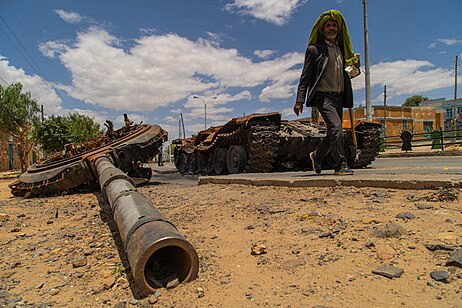
After some preliminary sporadic local clashes, the conflict turned into open hostilities. The Tigray War, as it went down in history, lasted for two full years (2020-2022), claiming the lives of over 100,000 people amid widespread atrocities and severe human rights violations from both sides.[43]
The war, rather than merely constituting an Ethiopian internal matter, rapidly acquired a regional character as a result of the Medemer-ignited regionalisation. Eritrean President Isaias Afewerki, now turned Ethiopian ally, intervened, crossing the Tigrayan border to protect the country from potential spillovers and exploit the situation to defeat its long-standing TPLF rivals.[44] Somalia also provided a small troop detachment (1,000-3,000) to support military operations in compliance with the 2018 Tripartite Agreement.[45]
At the same time, Abyi’s Omoro-Amhara original voting base crumbled into a parallel spiral of ethnic violence. The initial political liberalisation of 2018-2020 had already given space to multiple local grievances against the established power-sharing division from Oromo and Amhara organisations.[46] The subsequent rise of Federal Government interventionism and centralisation vis-a-vis the war revived Omoro nationalism, fuelling interethnic violence between the two peoples in Oromia. As the ENDF was distracted by the war in Tigray, the government increasingly resorted to reliance on Amhara nationalist militias, such as the infamous Fano group, to maintain order.[47] This move further alienated the Oromos, once Abyi’s closest allies, and in August 2021, the Oromo Liberation Army (OLA) formed an unexpected alliance with TPLF rebels.[48]
In November 2021, rebel forces captured the strategic city of Mekelle, paving the way to what seemed the final march on Addis Ababa. However, the offensive, ill-prepared and inadequately coordinated, resulted in a catastrophic defeat of the rebel forces by the coalition comprising the ENDF, the Eritrean army and Amhara-nationalist militias-[49] The Ethiopian government negotiated a favourable Cessation of Hostilities Agreement (CoH) in Pretoria and reasserted control over Tigray.
Nevertheless, the conflict had profound and multiple disruptive repercussions on Ethiopian foreign policy, the Medemer agenda and the regional international architecture. The first is the most manifest, as Abyi Ahmed’s premiership weakened Ethiopia’s[MS5] [Ug6] institutional stability, causing a costly conflict which almost led to his dethronement. Mirroring the previous EDPRF foreign policy, Medemer’s new course from 2018 was inextricably connected to domestic dynamics, intending to place domestic consolidation and economic development at the core of its new centralising programme. Despite resounding commitments, Abyi’s “synergy and harmony” reforms produced the opposite outcome, leaving behind a war-torn, devastated and ethnically divided country.
At the same time, agreements and region-building initiatives with historic rivals revealed their double-hedged nature. While the alliance with Eritrea’s president Isayas Afewerki permitted Abyi to stay in power, it demonstrated the fragile nature of Ethiopian hegemonic velleities. In the aftermath of the Pretoria Agreements, which didn’t include Eritrea, Eritrean troops still occupied consistent parts of Northern Tigray.
As previously mentioned, Sonia Le Gouriellec argued against the “benign hegemon thesis” that Ethiopia, despite presenting some hegemonic features, was an imperfect hegemon as it lacked the ambition and the capability to impose rule adherence on its neighbours. In recent years, Abyi’s international activism prompted the opposite discourse, as many saw Ethiopia as a “powerhouse in the making”.[50] However, the post-war reality staggeringly differs from both these theories. Indeed, despite the complexity of the definition of hegemony in the IR literature, it is safe to affirm that no regional hegemon is the playground for its neighbours’ military forces, let alone enduring occupation by them.[51]
Furthermore, the war jeopardised Abyi’s ambitions of extending his region-building projects to Sudan and establishing Ethiopia as a mediator between factions in the Sudanese Civil War, reigniting tensions in the contested border region of the fertile Al-Fahsaga region.[52] The area, inhabited by Amhara farmers since the 20th century but internationally recognised as part of Sudan, has long represented a point of friction between the two countries. During the EPRDF rule, a compromise was reached in 2008, with Ethiopia recognising it as part of Sudan and the latter granting the right to stay to the inhabitants.[53] However, Ethiopia’s weakness during the Tigray war and the activism in the area by Amhara militias induced the Sudanese Armed Forces (SAF) to occupy it and forcibly expel its inhabitants in December 2020. In retaliation, Fano and other Amhara armed groups crossed the border and occupied it, demonstrating the incapability of the Federal Government to control the forces it unleashed.[54] The diplomatic crisis with Sudan also dramatically menaces Ethiopia’s position in the contention over the GERD project. Coupled with the fall of the relatively pro-Ethiopian President Al-Bashir in 2019, the Al-Fashaga issue has led to a Sudanese policy realignment in favour of Egypt‘s position on the GERD[55][56]
Finally, the most negative impact of the Tigrayan conflict is unquestionably its repercussions on Abyi’s image and reputation, a fundamental component of his personalised foreign policy approach. Once a charismatic Nobel prize recipient and widely recognised peacemaker, the Ethiopian prime minister now faces multiple accusations of genocide, war crimes, use of starvation as a weapon, and acquiescence over mass rapes and tortures.[57] As a consequence, France chose to cut an 85 million euro military loan programme, and relations with the EU heavily deteriorated, leading to the suspension of almost one billion euros in aid funds.[58] The High Representative for Common Foreign Security Policy, Josep Borell, called for the enactment of sanctions[59] Parallelly, the US suspended trade benefits and restricted aid over human rights concerns, while the US Congress described US-Ethiopian relations in 2020-2022 as severely strained.[60]
Re-bound and the “Hawkish turn”: 2022-2024
Not only had the war exposed Ethiopian vulnerability, but it also catalysed quests for reshaping the Horn of Africa’s geopolitical architecture. Deprived of its region-builder image, Ethiopia found itself surrounded by hostile powers and growing antagonisation, namely by Sudan and Egypt, weakened within the IGAD and vulnerable vis-à-vis Eritrean cross-border activism. As of 2024, border skirmishes with Sudan are recurring and tensions with the Eritrean occupying forces in Tigray are mounting.[61]
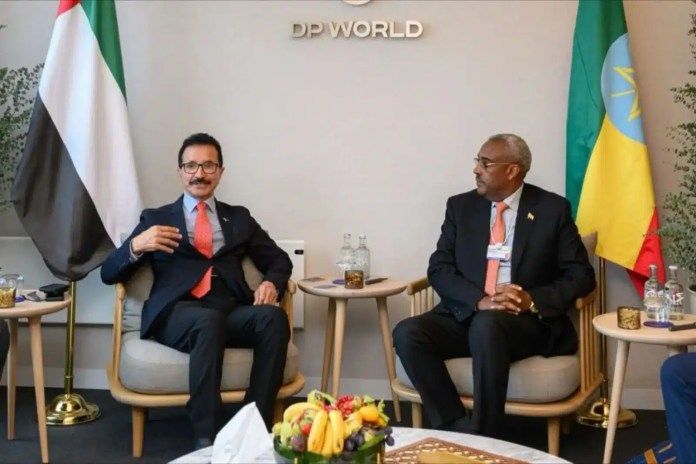
Moreover, welcoming investments in the region from external actors also inadvertently stimulated their strategic attention. In recent years, the UAE deepened its commitments in Somalia, unquestionably the frailest actor in the area, strengthening its financial support to the separatist Somaliland authorities and the largely autonomous Puntland State-[62] Through the state-owned Dubai Ports World company (DP World), it established a foothold in the region, acquiring operations of the Somaliland-controlled Berbera Port and later establishing a military base for its protection.[63] Turkey, in open competition with the Gulf States, strengthened support for the federal Somali National Army (SNA), established military bases in Mogadishu and even recently announced the creation of a Turkish Space Agency centre on Somali territory.[64]
In turn, post-war Ethiopia reacted by adopting an increasingly assertive, if not openly aggressive, foreign policy posturing, reviving its long-standing maritime aspiration. In January 2024, with the UAE’s acquiescence, it signed a Memorandum of Understanding (MoU) with Somaliland and obtained co-participation in the Berbera Port authority, suggesting a potential official recognition of the non-recognised state. This manoeuvre offered Ethiopia the possibility to reduce its almost 90% trade dependency on Djibouti and avoid signing a similar accord with Eritrea.[65]
The accords sparked new tensions in the region, leading to harsh protests from Somalia and Eritrea and the de facto termination of the 2018 Tripartite Agreement, once Abyi’s greatest success. In August 2024, Somalia, Eritrea and Egypt convened a summit in Asmara to enhance strategic cooperation between them, which signalled, according to the Institute for the Study of War (ISW), the birth of an anti-Ethiopia alliance.[66] Within this new framework, Egypt agreed to deploy substantial troops to Somalia by the end of the year.[67]
Ethiopia reacted firmly by resuming its long practice of interventions in Somalia, occupying in September key airports and strategic areas in the bordering Somali Gedo region to prevent Egyptian deployments there.[68] At the moment, Ethiopia-Somalia pacification talks have been ongoing since December 2024 in the context of heightened tensions and mutual distrust.
Furthermore, Abyi Ahmed renewed his policy of engagement with global actors, this time in an increasingly balanced and transactional way. Addis Ababa signed in 2021, amid the Tigray war and international isolation, a military cooperation agreement with Russia and welcomed in 2024 Russian foreign minister Sergey Lavrov for strategic talks. During the conflict, Ethiopian officials also adopted a growingly anti-western discourse.[69] However, in the aftermath of the Pretoria Agreements, Abyi Ahmed resumed phone calls with the White House, prompting a softening of the US policy towards Ethiopia and leading to a visit by State Secretary Anthony Blinken to the country.
Under pressures from Ethiopia’s liaisons with the Russian Federation, the US and the EU started considering lifting restrictions on aid. USAID resumed 2023 food distribution in the count, and the State Department acknowledged “the end of gross and systematic human rights violations”.[70] At the same time, Ethiopia engaged in talks with the World Bank and the International Monetary Fund, whose managing director Kristalina Georgieva visited Ethiopia in the past weeks and praised Abyi Ahmed’s reform course encouraging foreign partners to invest in the country.[71]
Ethiopian newly emerging hawkism may seem at first sight at complete odds with Abyi’s initial Medemer formulation of synergy and willingness to peacefully engage with its neighbours, resembling, to a greater extent, the former EPRDF foreign policy. However, it is a direct and by-product[Ug7] consequence of the chain of events inadvertently ignited by it. Moreover, despite clear differences in tone and conduct, the new hawkish posture of the Abiy administration still manifests some of the core pillars of Medemer in the context of a divided and conflictual region. Indeed, it reflects its longstanding grandeur and hegemonic ambitions vis-à-vis neighbours and perpetuates its preference for bilateral action in defiance of the African Union and IGAD. The Berbera Port agreement epitomises this phenomenon and represents a continuation of the Abiy-sponsored alliance with the UAE in a newly assertive and strategic fashion. It is difficult to determine whether Ethiopia will be dragged into the rising Turkey-UAE competition that arose in the growing regional power vacuum; nonetheless, the alignment with Emirati positions in the Berbera Port issue and the tensions in Somalia seem to suggest so. Proactive engagement with the West also remains a fil-rouge of Ethiopian foreign policy, yet in a more aggressive and transactional style after the fall in despair of Abyi’s reputation among Euro-Atlantic decision-makers and the overture toRussian assertiveness in Africa.
Conclusions
In conclusion, the evolution of Abiy Ahmed’s foreign policy from the initial optimism of the Medemer era to the assertive and conflict-driven stance post-2022 illustrates a dramatic reversal in Ethiopia’s international standing. Initially heralded as a peacemaker and reformist, Abiy’s early years in office saw unprecedented efforts to promote regional integration and peace, particularly through the historic peace deal with Eritrea and the establishment of the 2018 Tripartite Agreement with Somalia and Eritrea. These initiatives, driven by a neoliberal and humanist vision, sought to redefine Ethiopia’s role in the Horn of Africa by fostering cooperation rather than confrontation while at the same time establishing the country as a leading semi-hegemonic regional power.
However, the causes of its evolutionary trajectories ultimately lie in Medemer itself, particularly in its domestic power consolidation agenda and the unforeseen repercussions it instigated. The Tigray War of 2020-2022 derailed Abiy Ahmed’s ambitious regional projects, de facto consolidating an anti-Ethiopian alliance in the Horn of Africa and its proximate regions. Parallelly, it undermined Ethiopia’s institutional stability, exacerbating deep-rooted ethnic fractures and disrupting Abiy Ahmed’s unifying velleities and reputation as a benevolent visionary statesman. The vacuum of power favoured the penetration of external actors Ethiopia itself attracted to the region, in a worryingly competitive and hostile pattern.
Caught by uncontrollable forces amid growing uncertainty, Ethiopia, in response, shifted to a more assertive and hawkish posture to contain damage and preserve its position in the volatile region, reminiscing of past foreign policies Abiy Ahmed himself pledged to overcome. Nevertheless, continuity with the post-2018 course remains dominant, albeit in a peculiar synthesis with more aggressive and transactional tones toward neighbours and foreign partners.
The current positioning of Ethiopia collides with previous theoretical conceptualisations, such as the notion of imperfect hegemony or benign hegemony, suggesting that it is too early to determine whether Ethiopia will smoothly carve for itself a new role in the regional architectures, opt for assertive revisionism or fall into further internal turmoil. While it is unquestionable that Ethiopia’s rapid policy realignment to safeguard its interests may reassert its influence, the risk of destabilisation spillovers across the Horn of Africa and the Red Sea remains high and pervasive and presents increasing features of aggressive intra-power competition. The only certainty for Ethiopia is that the juxtaposition of ambitious and individual-centred policy packages in open disregard of structural and historical drivers of foreign policy and domestic cleavages has brought everything but synergy, signalling an important lesson to statesmen on the hybris of transformative leaders.
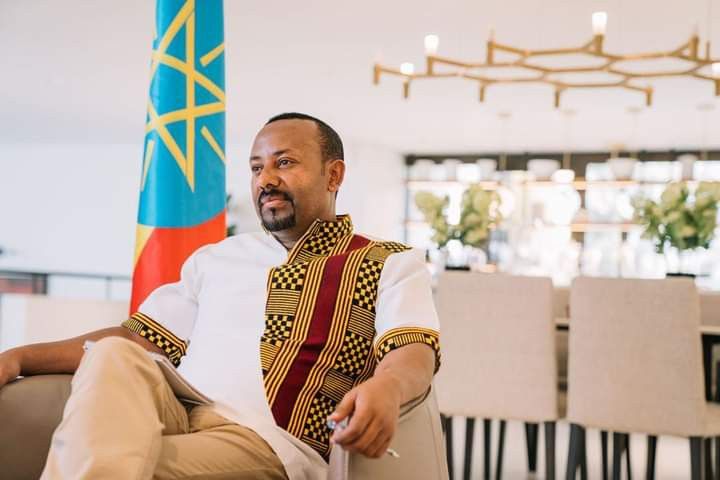
Cover image: Abiy Ahmed, yadimedianetwork
[1] United States Institute of Peace, “Changing Ethiopia: Understanding Medemer”, event video, November 20, 2019, https://www.usip.org/events/changing-ethiopia-understanding-medemer.
[2] Sara Mokkadem, “Abiy Ahmed’s ‘Medemer’ Reforms: Can It Ensure Sustainable Growth for Ethiopia and What Are the Challenges Facing the New Government?”,Policy Center for the New South, March 2019.
[3] Giovanni Faleg, “Resetting Ethiopia: Will the State Heal or Fail?”, European Union Institute for Security Studies, 2019.
[4] Adyita Sakar, “Two-Level Game or the Primacy of Domestic Politics? Ethiopia’s Regional Foreign Policy after 2018”, PeaceRep: The Peace and Conflict Resolution Evidence Platform, 2022.
[5] Ibid.
[6] Whitney Schneidman, “Ethiopia: Africa’s next Powerhouse?”, Brookings, March 26, 2019, https://www.brookings.edu/articles/ethiopia-africas-next-powerhouse/.
[7] Government of Ethiopia, “Foreign Affairs and National Security Policy and Strategy” (Addis Ababa, November 2002), pp. 1-79.
[8] Mehdi Labzaé and Sabine Planel, “We Cannot Please Everyone: Contentions over Adjustment in EPRDF Ethiopia (1991–2018)”, International Review of Social History 66, no. 2 (2021): 69–91, https://doi.org/10.1017/S0020859021000158.
[9] Seyoum Mesfin and Adbet Dryssa Beyene, “The Practicalities of Living with Failed States”, 2018.
[10] John James Quinn and Seyma Akyol, “Ethiopian Foreign Policy: A Weak State or a Regional Hegemon?”, Journal of Asian and African Studies 56, no. 5 (2021): 1094-1118, https://doi.org/10.1177/00219096211007649
[11] Ibid.
[12] Quinn and Akyol, “Ethiopian Foreign Policy”.
[14] Sonia Le Gouriellec, “Regional Power and Contested Hierarchy: Ethiopia, an ‘Imperfect Hegemon’ in the Horn of Africa”, International Affairs, no. 5 (2018): 1059-1075, https://doi.org/10.1093/ia/iiy117.
[15] Harry Verhoeven, “Africa’s Next Hegemon: Behind Ethiopia’s Power Plays”, Foreign Affairs, April 12, 2015, https://www.foreignaffairs.com/articles/ethiopia/africas-next-hegemon.
[16] Quinn and Akyol, “Ethiopian Foreign Policy”.
[17] Malancha Chakrabarty, “Ethiopia–China Economic Relations: A Classic Win–Win Situation?”, World Review of Political Economy 7, no. 2 (2016): 226-248, https://www.jstor.org/stable/10.13169/worlrevipoliecon.7.2.0226.
[18] Ibid.
[19] Sarkar, “Two-Level Game”.
[20] Francesca Caruso, “Ethiopia’s Grand Renaissance Dam: The Law, History, Politics and Geopolitics Behind Africa’s Largest Hydropower Project”, Istituto Affari Internazionali, 2022, https://www.iai.it/en/pubblicazioni/ethiopias-grand-renaissance-dam.
[21] Ibid.
[22] Sarkar, “Two-Level Game”.
[23] Ibid.
[24] Giovanni Faleg, “Resetting Ethiopia”.
[25] Bronwyn Bruton, “Ethiopia and Eritrea Have a Common Enemy”,Foreign Policy, July 12, 2018, https://foreignpolicy.com/2018/07/12/ethiopia-and-eritrea-have-a-common-enemy-abiy-ahmed-isaias-afwerki-badme-peace-tplf-eprdf/.
[26] Sarkar, “Two-Level Game”.
[27] Ibid.
[28]Bronwyn Bruton, “Ethiopia and Eritrea Have a Common Enemy”.
[29] Sarkar, “Two-Level Game”.
[30] Quinn and Akyol, “Ethiopian Foreign Policy.”
[31] Faleg, “Resetting Ethiopia”.
Ylönen, Aleksi. “From Demonisation to Rapprochement: Abiy Ahmed’s Early Reforms and Implications of the Coming Together of Ethiopia and Eritrea.”, Peace & Security 31, no. 3 (2019): 341-349. https://doi.org/10.1080/14781158.2019.1546685.
[32] Sara Mokkadem, “Abiy Ahmed’s ‘Medemer’ Reforms: Can It Ensure Sustainable Growth for Ethiopia and What Are the Challenges Facing the New Government?”, Policy Center for the New South, March 2019.
[33] Ylönen, “From Demonisation to Rapprochement”.
[34] Whitney Schneidman, “Ethiopia: Africa’s next Powerhouse?”, Brookings, March 26, 2019, https://www.brookings.edu/articles/ethiopia-africas-next-powerhouse/.
[35]United States Institute of Peace, “Changing Ethiopia”.
[36] Quinn and Akyol, “Ethiopian Foreign Policy”.
[37] Faleg, “Resetting Ethiopia”.
[38] Sarkar, “Two-Level Game”.
[39] Ibid.
[40] Kristína Melicherová, Mirjam Van Reisen, and Daniel Tesfa, “Game Over: Key Markers of the Tigray War in Redefining the Region”, in Tigray. The Hysteresis of War, eds. Mirjam Van Reisen and Munyaradzi Mawere, vol. 1 (Bamenda: Langaa, 2024), 41-95. https://doi.org/10.2307/jj.22136029.8.
[41] Abdisa Olkeba Jima, “Ethiopian Political Crisis after Reform: Causes of Tigray Conflict”, Cogent Social Sciences 9, no. 1 (2023): 2209991, https://doi.org/10.1080/23311886.2023.2209991.
[42] Ibid.
[43] Melicherová, Van Reisen, and Tesfa, “Game Over.”
[44] Ibid.
[45] Ibid.
[46] Sarkar, “Two-level Game”.
[47] Melicherová, Van Reisen, and Tesfa, “Game Over.”
[48] Ibid.
[49] Ibid.
[50] Schneidman, “Ethiopia: The next African Powerhouse?”.
[51] Goda Dirzauskaite and Nicolae Cristinel Ilinca, “Understanding Hegemony in International Relations Theories”, Aalborg University, 2017.
[52] Sarkar, “Two-Level Game”.
Caruso, “Ethiopia’s Grand Renaissance Dam”.
[53] Caruso, “Ethiopia’s Grand Renaissance Dam”.
[54] Ibid.
[56] Ibid.
[57] Human Rights Watch, “We Will Erase You from This Land”: Crimes Against Humanity and Ethnic Cleansing in Ethiopia’s Western Tigray Zone”, April 6, 2022, https://www.hrw.org/report/2022/04/06/we-will-erase-you-land/crimes-against-humanity-and-ethnic-cleansing-ethiopias.
[58] Matina Stevis-Gridneff, “Europe Rethinks Russia’s Influence in Ethiopia,” Politico, January 27, 2023, https://www.politico.eu/article/europe-russia-ethiopia-rethink/.
[59] Ibid.
[60] Lauren Ploch Blanchard, “Ethiopia:InBrief”, Congressional Research Service, January 11, 2024, https://crsreports.congress.gov.
[61] Sarkar, “Two-Level Game”.
[62] Aleksi Ylönen, “A Scramble of External Powers and Local Agency in the Horn of Africa”, CIDOB Notes Internacionals 280 (October 2022), https://www.cidob.org/en/publications/publication_series/notes_internacionals/n1_280.
[63] Ibid.
[64] Ibid.
The Economist, “Turkey Is Building a Spaceport in Somalia”, The Economist, February 6, 2025, https://www.economist.com/europe/2025/02/06/turkey-is-building-a-spaceport-in-somalia.
[65] Ibid.
[66] Institute for the Study of War, “AfricaFile.October 17, 2024: Egypt-Eritrea-Somalia Summit; Challenges with Tigray Peace Process”, October 17, 2024, https://www.understandingwar.org/backgrounder/africa-file-october-17-2024-egypt-eritrea-somalia-summit-challenges-tigray-peace.
[67] Ibid.
[68] Al Jazeera,“Ethiopian Forces Seize Key Airports in Somalia’s Gedo Region,” September 18, 2024, https://www.aljazeera.com/news/2024/09/18/ethiopian-forces-seize-key-airports-in-somalias-gedo-region.
[69] Lauren Ploch Blanchard, “Ethiopia: In Brief”, Congressional Research Service Report, January 11, 2024, https://crsreports.congress.gov.
[70] Ibid.
[71] Mahachi, ”Josephine, IMF Chief: ‘Africa Deserves to Be Represented More ”, Fairly Deutsche Welle, October 9, 2024. https://www.dw.com/en/imf-head-kristalina-georgieva-says-africa-needs-greater-representation-in-global-lending-body/a-70436320.

 Osservatorio Strategico Mediterraneo Allargato